

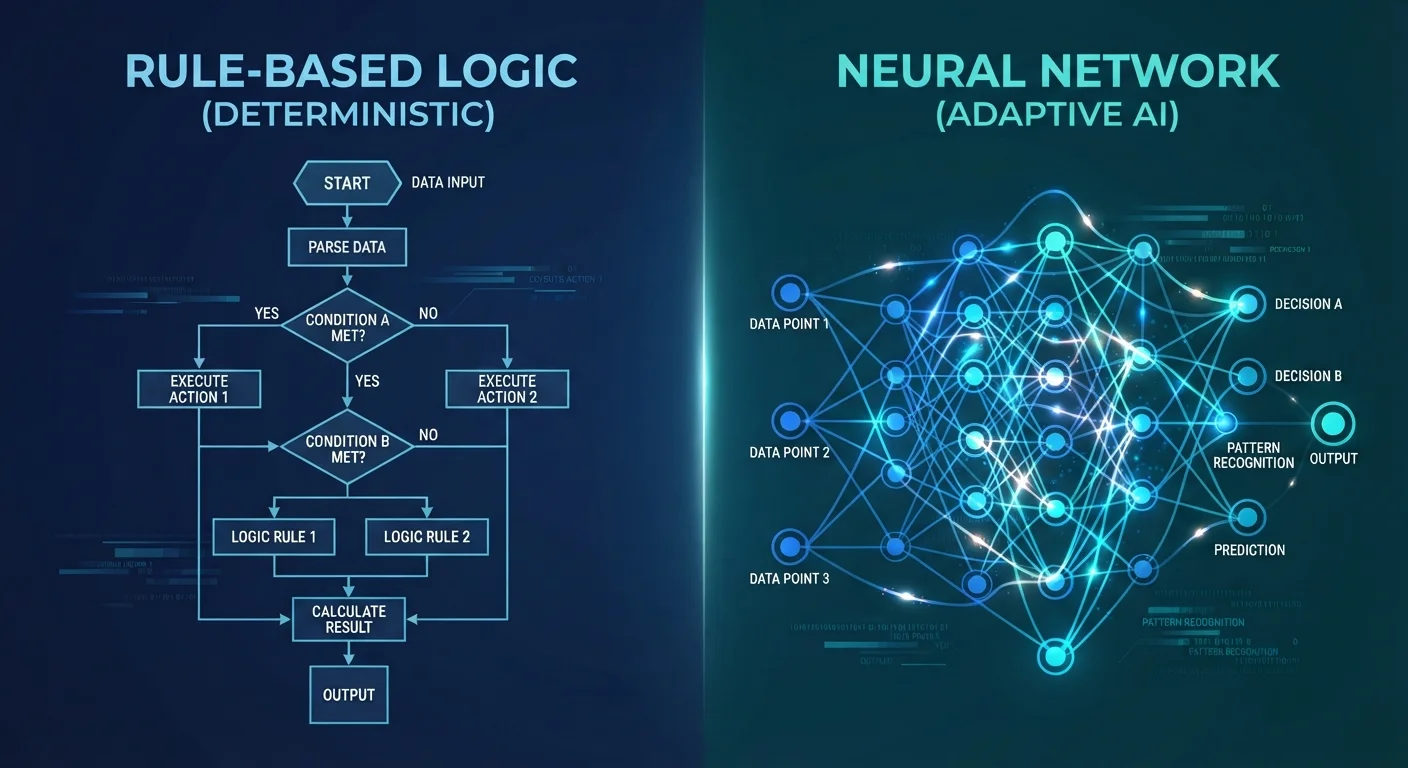
Option A
Traditional Software
The rule-driven, deterministic approach to computing.
Best for: Tasks with clearly defined logic, predictable inputs, and outcomes that must be fully explainable and auditable.
Option B
Neural Networks
The data-trained, pattern-learning architecture powering modern AI.
Best for: Tasks involving complex, unstructured data — such as image recognition, language processing, or fraud detection — where rules are hard to write by hand.
Two Fundamentally Different Ways to Build Software
When most people imagine software, they picture something like a recipe: if this happens, do that. That intuition is exactly right for traditional software. A programmer writes explicit instructions — conditional logic, loops, and calculations — and the computer follows them precisely every time. The behavior is fully determined by the code.
Neural networks work differently at a foundational level. Rather than following instructions written in advance, they are trained on large collections of examples. Through that training process, the network adjusts millions of internal numerical parameters — called weights — until it reliably produces correct outputs for the inputs it has seen. It doesn't receive a rulebook; it builds one implicitly from data. For a deeper look at how that training data shapes the result, see our explainer on training data.
The practical consequence: traditional software is written, while a neural network is essentially grown.
Head-to-Head: Key Differences at a Glance
The contrast between these two approaches spans behavior, transparency, and what kinds of problems each handles well.
| Criterion | Traditional Software | Neural Networks |
|---|---|---|
| How behavior is defined | Explicit rules written by programmers | Learned from labeled training examples |
| Predictability | Fully deterministic — same input, same output | Probabilistic — outputs can vary |
| Explainability | High — every decision traces to code | Often low — decision process is opaque |
| Handles unstructured data | Poorly — rules must be hand-crafted | Well — patterns extracted automatically |
| Error diagnosis | Straightforward — find the flawed rule | Complex — bias may be distributed across weights |
| Improves with more data | No — requires manual code changes | Yes — retraining updates performance |
| Typical use cases | Payroll, databases, calculators | Image recognition, language models, spam filters |
Neither column represents a universal winner. Which approach is appropriate depends entirely on the task, the tolerance for error, and the need for explainability.
Where Each Approach Excels — and Falls Short
Traditional software dominates anywhere that correctness is binary and the rules are known. A payroll system, a traffic light controller, a tax calculator — these are problems where every edge case can be anticipated and coded. An error in output points directly to an error in logic, and fixing it is straightforward.
Neural networks earn their place when the rules are too complex, too numerous, or genuinely unknown. Recognizing a face, transcribing speech, or detecting whether an email is spam — humans do these things effortlessly but cannot articulate the precise rules they follow. Neural networks learn those patterns statistically rather than symbolically.
175B+
Parameters in large language model neural networks
GPT-3, released by OpenAI in 2020, contained approximately 175 billion trainable parameters — illustrating the scale at which modern neural networks operate.
~95%
Human-level accuracy in image classification benchmarks
Deep neural networks have matched or surpassed human performance on standard image recognition benchmarks such as ImageNet, according to published academic research.
Decades
Head start traditional software has in regulated industries
Rule-based software has been the foundation of financial and safety-critical systems since the 1960s, giving it a long compliance and audit history that AI systems are still building.
The tradeoff is interpretability. When a neural network makes a wrong call, identifying why is often difficult. Researchers and regulators are actively working on explainability tools, but it remains a real limitation — particularly in high-stakes applications like medical diagnosis or lending decisions. Traditional software, by contrast, can always be traced step by step.
It's also worth noting that these approaches are rarely mutually exclusive. Many production systems pair a neural network's perceptual abilities with traditional logic layers that enforce business rules or safety constraints on top of the AI's output. To understand the specific learning strategies neural networks use, this breakdown of supervised, unsupervised, and reinforcement learning offers useful context.
Why This Distinction Shapes How AI Behaves
When an AI system makes a surprising or harmful decision, the question of whether it relies on neural networks or traditional logic matters enormously for accountability. A miscoded rule can be identified and corrected. A network that has absorbed a bias from its training data may be much harder to diagnose or fix — because the problematic behavior isn't stored in any single line of code; it's distributed across millions of parameters.
This is why conversations about AI in sensitive areas — education, hiring, healthcare — increasingly center on transparency and auditability. The application of AI in classrooms is one domain where these questions are particularly active: neural-network-based tools can be powerful, but educators and policymakers need to understand that those tools behave differently from conventional software.
Understanding the underlying architecture doesn't require a computer science degree. It requires recognizing one core distinction: traditional software does what it was told to do, while a neural network does what its training led it to approximate. That difference shapes everything from how errors occur to how they get fixed — and it's why the distinction matters to anyone living alongside AI systems today.
The content on this site is for informational purposes only and is not a substitute for professional advice. Always consult a qualified professional for guidance specific to your situation.