

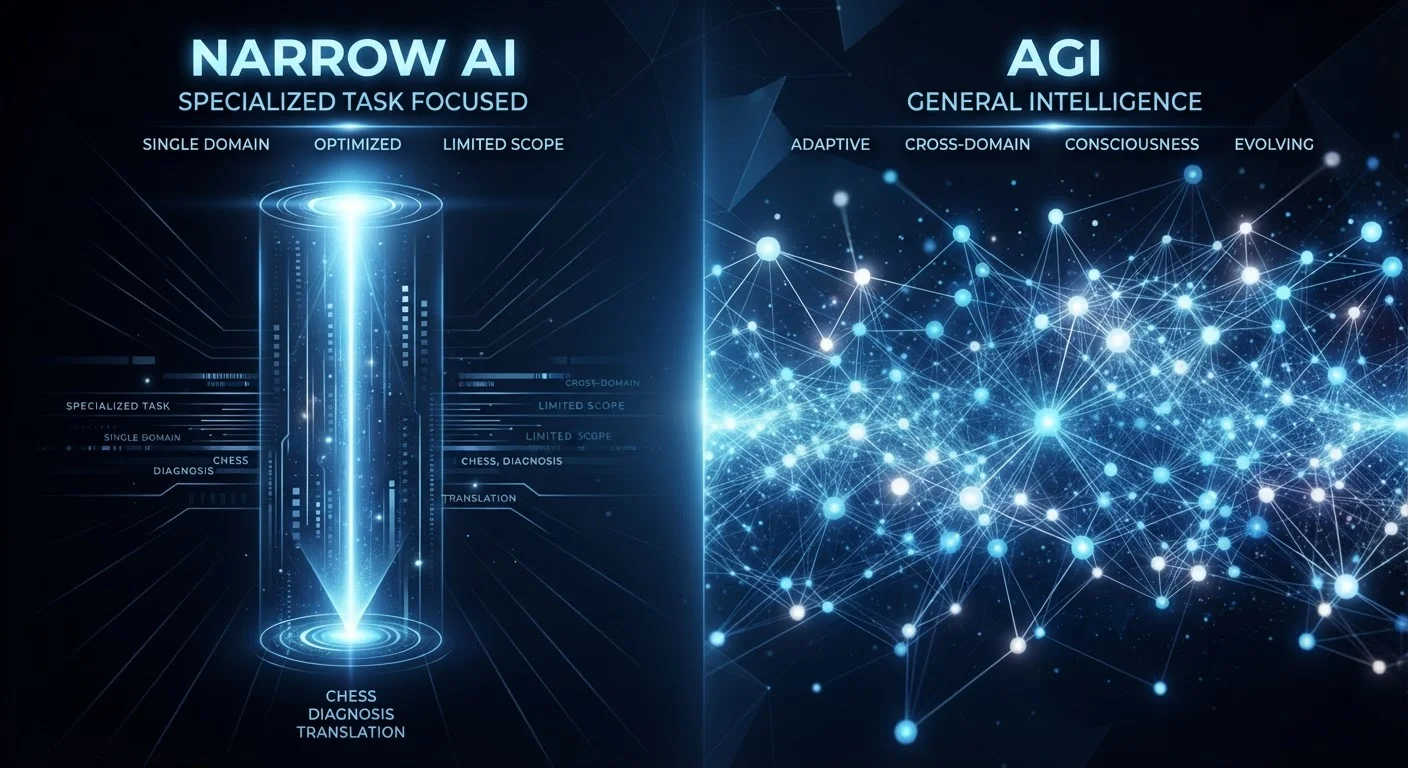
Option A
Narrow AI
The specialized, task-specific intelligence we use every day.
Best for: Automating specific, well-defined tasks such as translating text, recognizing images, or recommending content.
Option B
Artificial General Intelligence (AGI)
A theoretical, human-level intelligence that doesn't yet exist.
Best for: A concept used in research and public debate to describe AI that could reason flexibly across any domain — currently hypothetical.
Two Terms, One Persistent Confusion
When a chatbot writes a convincing essay or an AI model defeats world champions at chess, it's tempting to conclude that artificial general intelligence has arrived. It hasn't. What exists today — and what powers every AI product in the market — is narrow AI, also called weak AI or task-specific AI.
The confusion between narrow AI and AGI is more than semantic. It shapes how people evaluate risk, set policy expectations, and respond to technology headlines. Getting the distinction right is a prerequisite for following AI news with any accuracy. If you're new to these concepts, this primer on AI fundamentals is a useful starting point before diving into the comparison.
What Narrow AI Actually Is
Narrow AI describes any system trained to perform a specific task — and only that task. A spam filter, a medical image classifier, a language model generating text, a recommendation engine deciding what video plays next: all are narrow AI. Each operates within a tightly defined domain and cannot transfer that skill meaningfully to an unrelated problem.
The word "narrow" doesn't mean simple or unimpressive. Some narrow AI systems outperform humans on specific benchmarks — diagnosing certain cancers from scans, for example, or recognizing speech across thousands of languages. But performance on a defined task is categorically different from flexible, general reasoning.
| Criterion | Narrow AI | Artificial General Intelligence (AGI) |
|---|---|---|
| Current status | Widely deployed, commercially available | Theoretical; does not exist yet |
| Task scope | One specific domain or function | Any cognitive task a human can perform |
| Learning flexibility | Retrained per task or domain | Would transfer skills across domains autonomously |
| Real-world examples | Chatbots, image classifiers, spam filters | None — no confirmed example exists |
| Scientific consensus | Well-understood, actively researched | Definition and feasibility actively debated |
| Risk profile | Bias, misuse, reliability failures in defined tasks | Speculative long-term risks; premature to assess |
To understand why these systems work the way they do, it helps to know how they differ from conventional software. The distinction between neural networks and traditional software clarifies the underlying mechanics that make narrow AI both powerful and constrained.
What AGI Would Have to Be
Artificial General Intelligence is defined by flexibility. A true AGI system would, in principle, learn and reason across domains the way humans do — solving a novel engineering problem in the morning, interpreting poetry in the afternoon, and forming a strategic plan based on incomplete information by evening. It wouldn't need to be retrained for each new task.
No system today meets that definition. Researchers disagree significantly on how close current technology is to AGI, how to measure progress toward it, and whether the concept is even coherent as a technical target. These are open, contested questions — not settled science.
No consensus
Expert agreement on AGI timeline
Surveys of AI researchers show wildly divergent estimates for when or whether AGI might be achieved, with many experts declining to give a date at all.
1956
Year the term 'artificial intelligence' was coined
The Dartmouth Conference in 1956 introduced the term AI; the concept of general machine intelligence has been debated in research circles for nearly seven decades.
Billions
Daily interactions with narrow AI systems
From search engines and streaming recommendations to navigation apps and voice assistants, narrow AI mediates a substantial portion of daily digital life globally.
Much of the popular confusion stems from how impressively narrow AI can appear general. A large language model that answers questions about history, writes code, and explains recipes can seem to "know" everything. But it's pattern-matching across training data, not reasoning from first principles. Common misconceptions about how AI thinks explores exactly this gap between appearance and mechanism.
Why the Distinction Matters in Practice
Public discourse routinely blurs narrow AI and AGI in ways that have real consequences. When a company announces a "breakthrough" AI system, knowing which category it belongs to determines whether the claim is incremental progress or a genuine paradigm shift. Most announcements describe narrow AI improvements — meaningful, sometimes significant, but not evidence that general intelligence is around the corner.
Policy debates about AI regulation, safety, and economic disruption often pivot on which type of AI is being discussed. Regulations designed for narrow AI tools differ substantially from frameworks anticipating a system with open-ended reasoning capability. Conflating the two leads to either under-regulation of present harms or misdirected concern about hypothetical future ones.
For everyday consumers, the practical upshot is this: the AI assistant on your phone, the model generating images from text, and the algorithm curating your news feed are all narrow AI. They can be useful, flawed, biased, or misused — but they are not approaching general human intelligence. Understanding that gap is what lets you engage with AI news critically rather than reactively. For context on what today's AI actually produces, a plain-language explanation of generative AI helps place these systems accurately.
This article is for informational and educational purposes only. Claims about AGI timelines and capabilities reflect an active and unsettled area of research; readers should consult primary sources and peer-reviewed literature for the latest findings.
The content on this site is for informational purposes only and is not a substitute for professional advice. Always consult a qualified professional for guidance specific to your situation.