

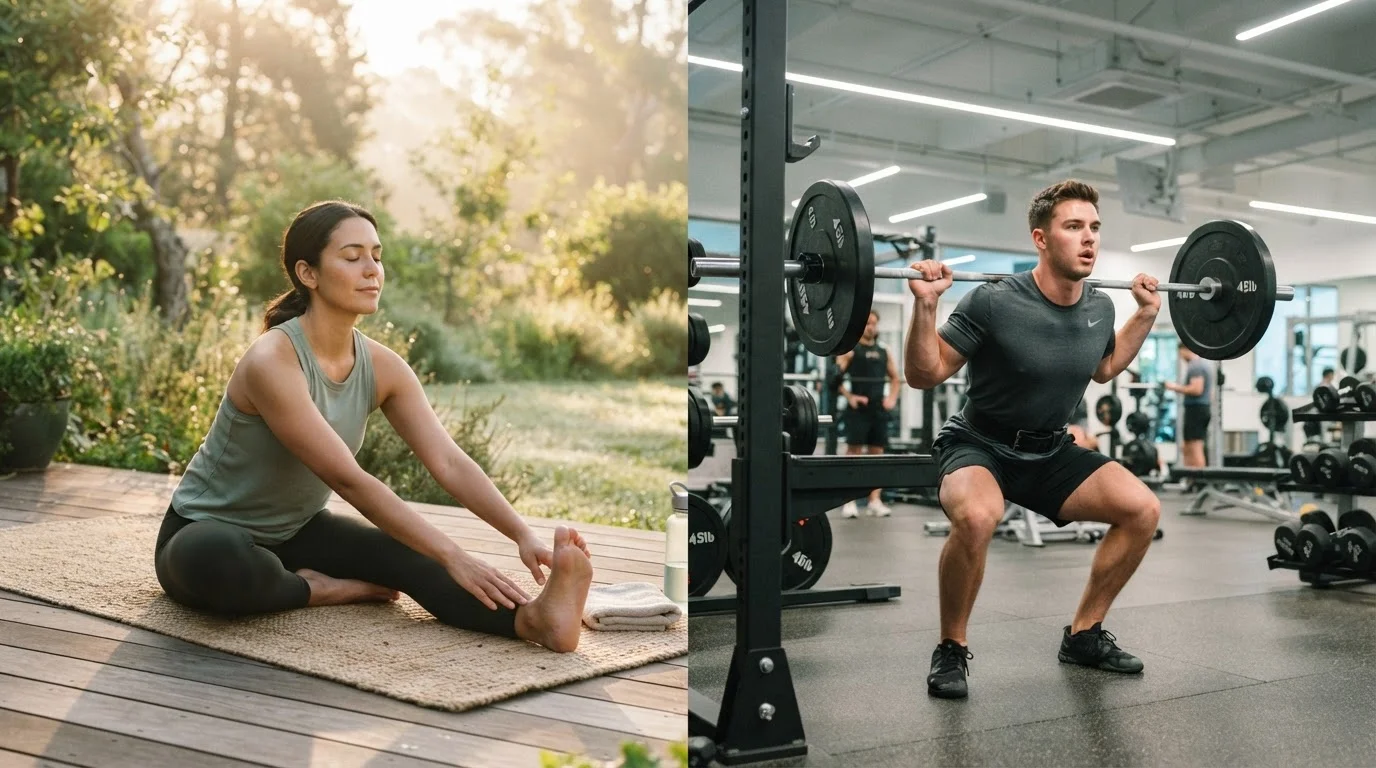
Option A
Mindful Movement
The body-aware, intuition-led approach to physical activity.
Best for: People who want to integrate movement into daily life with attention to how their body feels, rather than following a fixed performance target.
Option B
Structured Exercise
The planned, goal-oriented framework for physical training.
Best for: People who respond well to defined programmes, measurable progress, and scheduled sessions with clear fitness outcomes.
What Each Approach Actually Means
Mindful movement is an umbrella term for physical activity performed with deliberate attention to bodily sensation, breath, and present-moment awareness. It includes practices such as yoga, tai chi, qigong, walking meditation, and intuitive stretching. The goal is not to achieve a specific output — a faster mile, a heavier lift — but to cultivate a quality of presence during movement itself.
Structured exercise, by contrast, refers to planned, repeatable physical training designed around defined parameters: sets and repetitions, time intervals, heart rate zones, or progressive overload principles. Examples include strength training programmes, interval running plans, cycling schedules, and coach-prescribed swim workouts. Progress is tracked and adjusted over time toward measurable fitness outcomes.
The philosophical difference matters as much as the practical one. Mindful movement asks, How does this feel? Structured exercise tends to ask, What did I achieve? Both are legitimate orientations, and understanding them helps clarify which might align better with your goals and temperament. For a broader look at how attention-based practices work, see our breakdown of mindfulness versus meditation.
What the Evidence Says
Both approaches carry meaningful research support, though the bodies of evidence differ in scope and focus.
Structured exercise programmes have decades of controlled-trial data behind them. Studies published in journals such as the British Journal of Sports Medicine consistently link moderate-to-vigorous physical activity — including resistance training and aerobic exercise — to reduced risks of cardiovascular disease, type 2 diabetes, and all-cause mortality. Organisations including the Centers for Disease Control and Prevention (CDC) and the World Health Organization (WHO) base their physical activity guidelines on this evidence base.
Mindful movement has a smaller but growing body of research. Systematic reviews have found that yoga, for instance, is associated with reductions in perceived stress, improvements in flexibility, and modest benefits for blood pressure and sleep quality. Tai chi has been studied particularly in older adults, with some evidence suggesting benefits for balance and fall prevention. The mechanisms often involve the nervous system — practices that pair movement with breath tend to activate parasympathetic pathways associated with rest and recovery.
150 min
Weekly moderate activity recommended by WHO
The World Health Organization recommends at least 150–300 minutes of moderate-intensity aerobic activity per week for adults aged 18–64.
~55%
Adults meeting aerobic activity guidelines in the US
According to CDC data, roughly half of U.S. adults report meeting federal aerobic physical activity guidelines in any given year.
38%
Stress reduction associated with regular yoga practice
A 2018 systematic review in the Journal of Alternative and Complementary Medicine found meaningful reductions in self-reported stress among regular yoga practitioners.
It is worth noting that most mindful movement research involves self-reported outcomes and smaller sample sizes compared to structured exercise trials, so the certainty of findings varies. Neither category of activity is risk-free for all individuals — those with existing health conditions should get medical clearance before beginning any new programme.
How They Differ in Practice
| Criterion | Mindful Movement | Structured Exercise |
|---|---|---|
| Primary focus | Awareness, sensation, presence | Performance, output, progression |
| Typical examples | Yoga, tai chi, walking meditation | Strength training, interval running, swim plans |
| Progress measurement | Subjective: how you feel | Objective: reps, speed, weight lifted |
| Session structure | Flexible, often self-paced | Pre-defined, scheduled, repeatable |
| Research depth | Growing, smaller sample sizes | Extensive, large controlled trials |
| Stress and recovery emphasis | Central to the practice | Secondary; rest days scheduled separately |
| Equipment typically needed | Minimal (mat, comfortable clothing) | Varies widely; often gym or kit required |
One practical distinction worth highlighting: structured exercise often has a steeper initial learning curve for form and technique — particularly in resistance training, where incorrect mechanics can increase injury risk. Mindful movement practices are generally more self-directed, though beginners still benefit from qualified instruction, especially in yoga or tai chi, where alignment and sequencing matter.
For those whose schedules make consistency difficult, real-world strategies for fitting exercise into an unpredictable routine may be worth exploring alongside either approach.
Choosing a Path — or Combining Both
These two philosophies are not in opposition. Many practitioners incorporate elements of both: a structured strength programme on weekdays and a restorative yoga session on weekends, for example, or beginning each structured workout with a brief body-scan check-in. Research on hybrid approaches is still developing, but there is no evidence that mindful practices undermine performance training — and some suggestion that recovery and injury resilience may benefit when both are present.
What matters most is sustained engagement. Physical activity that a person actually does, consistently over time, produces health benefits; the optimal programme is often the one that fits a person's life, values, and preferences. For building complementary habits around mental wellness alongside physical activity, see how to design a daily mental wellness routine that sticks.
If you are considering adopting a new practice and want a framework for evaluating it critically, our guide on evaluating a wellness trend before committing offers useful questions to ask first.
This article is for general informational purposes only and does not constitute medical or professional health advice. Consult a qualified healthcare professional before starting, stopping, or significantly modifying any physical activity routine, particularly if you have an existing health condition.
The content on this site is for informational purposes only and is not a substitute for professional advice. Always consult a qualified professional for guidance specific to your situation.