

Where Did 'Eight Glasses' Come From?
The recommendation to drink eight 8-ounce glasses of water daily — often styled as "8x8" — has circulated in popular wellness culture for decades. Its origins are murky. A frequently cited explanation traces back to a 1945 U.S. Food and Nutrition Board recommendation suggesting roughly 2.5 liters of water per day for adults. Critically, the same document noted that most of this quantity "is contained in prepared foods" — a clause that was largely stripped from the advice as it filtered into public guidance over subsequent decades.
A 2002 review published in the American Journal of Physiology by Dr. Heinz Valtin examined the evidence for the 8x8 rule directly and found no scientific studies supporting it as a universal requirement for healthy adults. The rule persists not because of strong clinical backing, but because of cultural repetition.
What the Research Actually Says
Current guidance from bodies such as the National Academies of Sciences, Engineering, and Medicine (NASEM) frames hydration around total water intake — encompassing all beverages and moisture from food. Their dietary reference intakes suggest approximately 3.7 liters (125 ounces) per day for adult men and 2.7 liters (91 ounces) per day for adult women on average. These figures are population-level estimates derived from observational data, not clinical trials, and are not intended as individual targets.
~20%
Daily water intake from food sources
The National Academies of Sciences, Engineering, and Medicine estimates roughly one-fifth of daily water intake comes from solid food in typical diets.
3.7 L
Average total water intake for adult men
NASEM's adequate intake reference for total water — from all beverages and food — is approximately 3.7 liters per day for adult males.
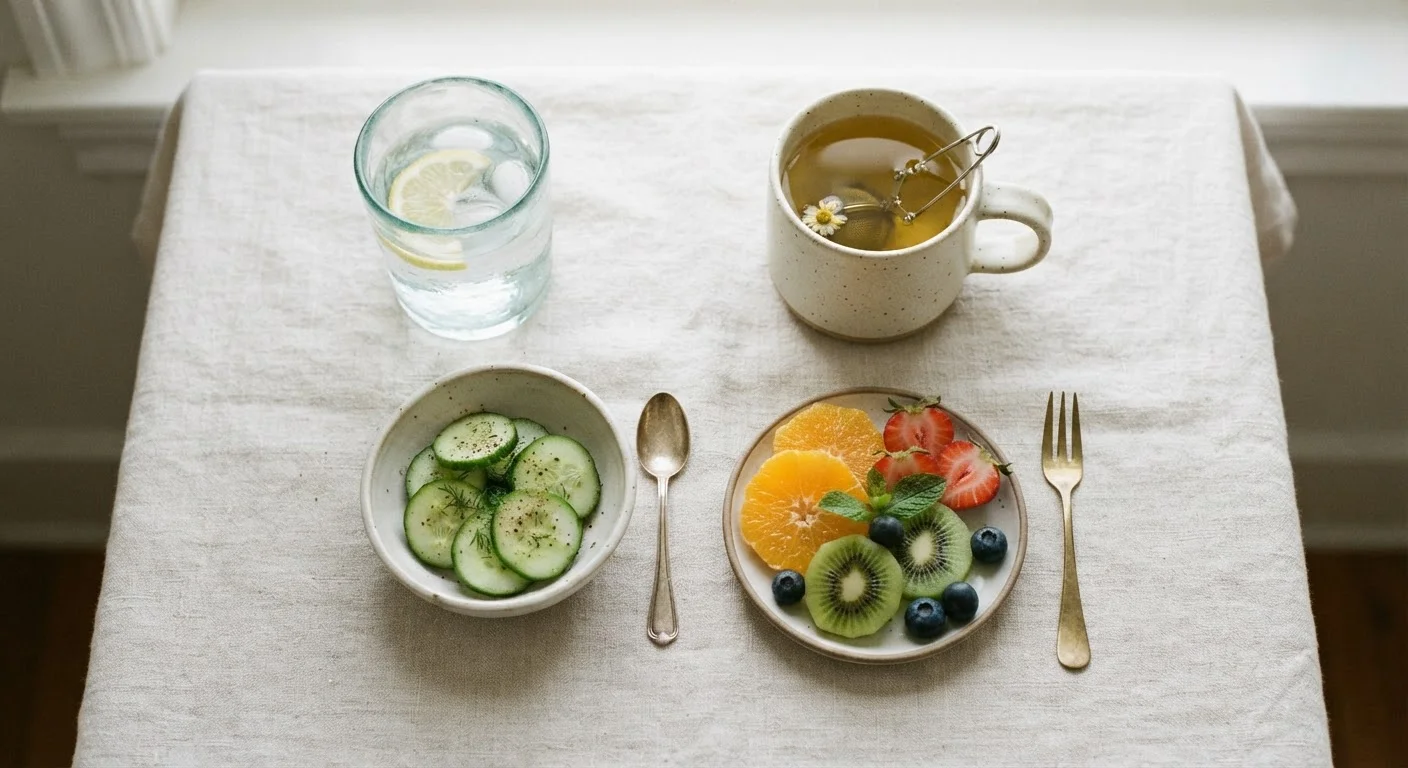
Importantly, NASEM notes that about 20% of water intake typically comes from food. Produce such as cucumbers, watermelon, strawberries, and leafy greens have water content exceeding 90% by weight, making diet composition a meaningful factor in hydration status.
Myth
You must drink exactly eight glasses of water every day to stay healthy.
Fact
There is no peer-reviewed evidence establishing eight glasses as a universal daily requirement. Needs vary considerably by individual and context.
The 8x8 rule is a simplification that was never grounded in controlled clinical research. Population-level dietary reference intakes use much broader ranges and account for water from all dietary sources, not just glasses of plain water. Applying a single rigid number to all adults ignores meaningful differences in body size, activity, and climate.
Myth
Coffee and tea dehydrate you and shouldn't count toward fluid intake.
Fact
For regular consumers, moderate caffeine intake does not cause net dehydration. Both coffee and tea contribute to daily fluid totals.
The idea that caffeine causes significant dehydration stems from studies showing a mild short-term diuretic response. However, research — including a review published in PLOS ONE — has found that moderate coffee consumption in habituated drinkers produces hydration outcomes comparable to water. The net fluid contribution outweighs the mild diuretic effect.
Myth
Thirst is an unreliable signal — by the time you feel thirsty, you're already dehydrated.
Fact
For most healthy adults, thirst is an effective physiological cue. It becomes less reliable in certain populations, such as older adults and endurance athletes.
The claim that thirst lags behind dehydration is frequently overstated in wellness media. In healthy adults with intact thirst mechanisms, the sensation is triggered by small changes in blood osmolality — a sensitive internal signal. Thirst sensitivity does decline with age and can be blunted during intense exercise, making those populations better served by more deliberate fluid monitoring.
Myth
Water is the only meaningful source of hydration.
Fact
Food — especially fruits and vegetables — provides a significant share of daily fluid intake, typically around 20% in average diets.
Many whole foods have very high water content. Cucumbers, lettuce, tomatoes, watermelon, and strawberries are among the most water-dense. Soups, smoothies, milk, and other beverages also contribute. Focusing solely on plain water consumption can lead people to underestimate their actual hydration status, particularly those who eat diets rich in produce.
Myth
Drinking more water than you need is always harmless — extra water is just excreted.
Fact
Excessive water intake can cause a condition called hyponatremia (dangerously low blood sodium), which is rare but medically serious.
Hyponatremia — a dilution of sodium in the bloodstream — can occur when large volumes of water are consumed faster than the kidneys can excrete the excess. It is most commonly seen in endurance athletes who over-drink during prolonged events, but can also affect people with certain kidney or hormonal disorders. While the condition is uncommon in the general population, it underscores that more water is not categorically better.
Factors That Genuinely Shift Your Needs
Hydration is not a fixed number — it is a moving variable. Several evidence-supported factors meaningfully alter how much fluid a person requires:
- Physical activity: Exercise increases fluid loss through sweat, with losses varying widely by intensity, duration, and individual sweat rate.
- Climate and environment: Heat and humidity accelerate perspiration; high altitude can also increase respiratory water loss.
- Body size and composition: Larger bodies and those with more lean muscle mass generally have higher total water requirements.
- Health status: Certain conditions — including kidney disease, heart failure, and some medications — can affect how the body handles fluids. People managing chronic conditions should consult a qualified healthcare professional rather than applying general population guidance.
- Pregnancy and breastfeeding: Fluid needs increase during both states; specific guidance should come from a healthcare provider.
Special Populations Need Tailored Guidance
General hydration guidance is not appropriate for everyone. People managing kidney disease, heart failure, diabetes, or other conditions affecting fluid regulation should work with a healthcare provider to establish appropriate intake levels. The same applies during pregnancy and breastfeeding. Older adults may have diminished thirst perception and benefit from more structured reminders to drink fluids throughout the day.
Practical Implications for Daily Life
For most healthy adults, thirst is a reasonably reliable indicator of hydration need — a point supported by physiological research on the body's osmoregulatory mechanisms. Urine color is another practical marker: pale straw-yellow generally indicates adequate hydration, while dark yellow or amber may suggest a need for more fluids.
Coffee and tea, despite long-standing claims to the contrary, do contribute to hydration. Research has consistently shown that the diuretic effect of moderate caffeine consumption is mild and does not offset the net fluid benefit in habitual consumers. Alcohol, however, does have a meaningful diuretic effect and should not be counted as a net hydration source.
The practical takeaway is not to abandon any interest in hydration, but to shift away from rigid numerical targets toward attentive, individualized awareness. Eating a diet rich in whole fruits and vegetables, drinking in response to thirst, and adjusting for activity and environment will serve most people more accurately than chasing a fixed daily glass count.
This article is for general informational purposes only and does not constitute medical advice. If you have questions about your personal hydration needs or a health condition affecting fluid balance, please consult a qualified healthcare professional.
The content on this site is for informational purposes only and is not a substitute for professional advice. Always consult a qualified professional for guidance specific to your situation.