

Option A
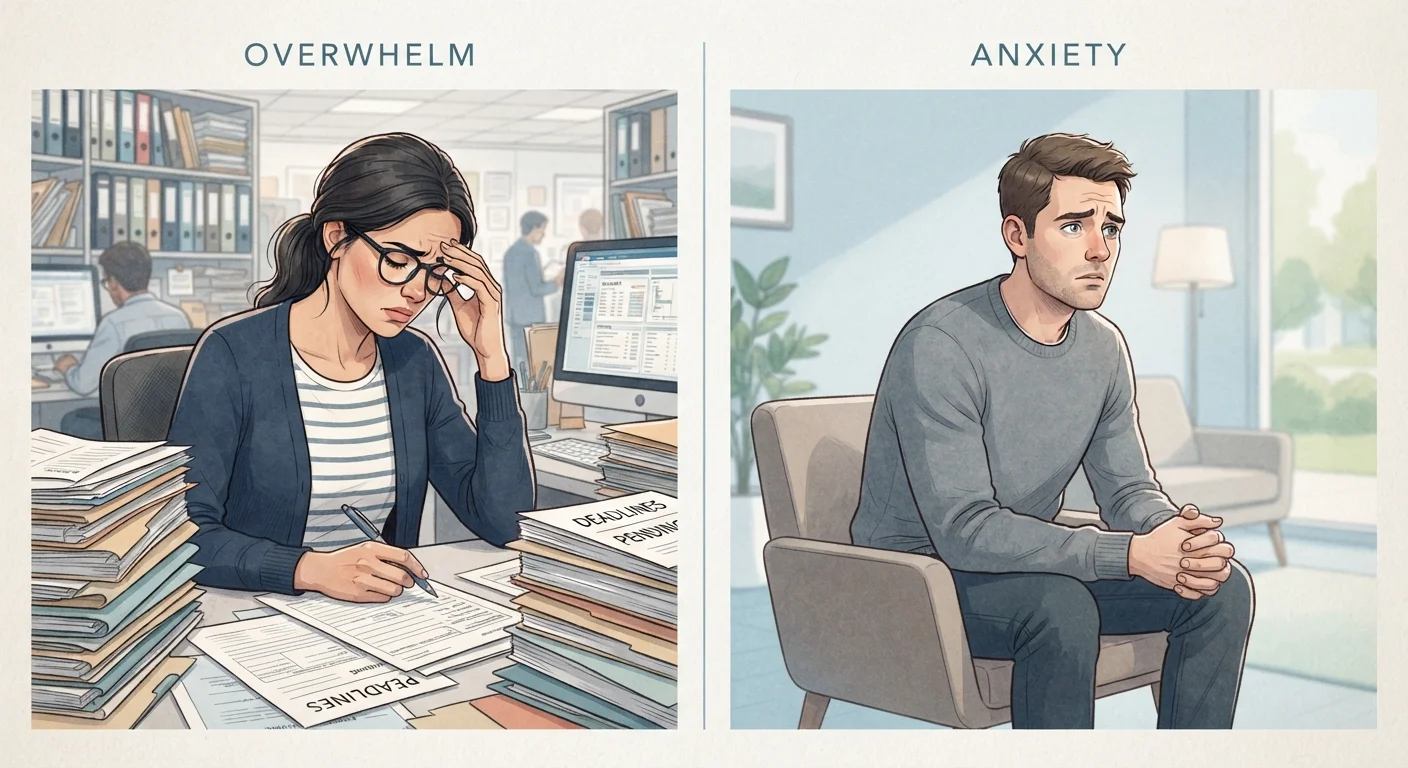
Stress
A response tied to an identifiable external pressure.
Best for: Understanding reactions to concrete life demands — work deadlines, financial strain, relationship conflict, or major life transitions.
Option B
Anxiety
A persistent internal state that can exist without a clear trigger.
Best for: Recognizing when worry and apprehension continue even after the external stressor has passed or is absent entirely.
What Separates Stress from Anxiety
Stress and anxiety share enough surface features — racing thoughts, physical tension, disrupted sleep — that the terms are often used as though they are interchangeable. They are not. The distinction matters, because the two experiences have different origins and, when support is needed, may call for different approaches.
Stress is generally understood as a response to an external demand or pressure. A looming deadline, a difficult conversation, unexpected financial strain — these are identifiable stressors. The stress response is adaptive: the body mobilizes energy and attention to meet the challenge. When the stressor is removed or resolved, the stress typically subsides along with it.
Anxiety, by contrast, is characterized by worry or apprehension that can persist even when no clear external threat is present, or that feels disproportionate to the actual situation. It tends to be more future-oriented and internally driven. While some anxiety is a normal part of human experience, anxiety disorders — clinical conditions diagnosed by mental health professionals — involve anxiety that is persistent, difficult to control, and interferes with daily functioning.
| Criterion | Stress | Anxiety |
|---|---|---|
| Primary trigger | Identifiable external stressor | Internal; may lack a clear cause |
| Duration | Typically resolves with the stressor | Can persist beyond or without a trigger |
| Orientation | Present-focused (current demands) | Often future-focused (anticipated threat) |
| Proportionality | Generally proportionate to the situation | May feel excessive or hard to control |
| Clinical classification | Not a disorder in itself | Can meet criteria for an anxiety disorder |
| Physical symptoms | Common during the stressful period | May be persistent and broadly present |
Overlapping Symptoms and Why the Confusion Happens
Both stress and anxiety can produce similar physical and psychological symptoms: an elevated heart rate, muscle tension, irritability, difficulty concentrating, and disturbed sleep. This overlap is one reason people conflate the two. The body's physiological stress response — sometimes called the fight-or-flight reaction — is engaged in both cases, which is why the physical experience can feel nearly identical in the short term.
The key differentiating questions tend to be about duration, proportionality, and the presence of a trigger. Does the feeling ease when the pressure lifts? Is the level of worry roughly proportionate to what's actually happening? Is there a concrete source that can be named? Answers pointing toward persistence, pervasiveness, and disproportionality shift the picture toward anxiety.
Normal Anxiety vs. Anxiety Disorders
Experiencing anxiety at certain points in life — before a major event, during uncertainty, or in genuinely risky situations — is a normal human response. Anxiety disorders, as defined by clinical frameworks like the DSM-5, involve anxiety that is persistent, excessive, and impairs functioning. Only a qualified mental health professional can assess whether someone's experience meets diagnostic criteria. This distinction is important: it separates everyday emotional experience from a condition that may benefit from structured treatment.
It's also worth noting that chronic stress — sustained over a long period — can contribute to the development of anxiety disorders. The relationship between the two is bidirectional and not always clean. This is one reason professional evaluation is valuable when either experience becomes difficult to manage.
When to Seek Support
Neither stress nor anxiety needs to reach a crisis point before speaking with a professional makes sense. If either experience is significantly affecting quality of life, relationships, work, or physical health, that is a reasonable basis for seeking evaluation. Mental health professionals — including therapists, counsellors, and psychiatrists — can assess what's happening and discuss what kinds of support may be appropriate. For a clearer sense of how those roles differ, see our breakdown of therapy, counselling, and psychiatry.
Self-directed approaches — such as mindfulness practices — are widely studied in the context of both stress reduction and anxiety management, though their role varies depending on the severity of symptoms. For a closer look at how those practices compare, mindfulness vs. meditation offers a useful side-by-side. These approaches are generally considered complementary to professional care rather than substitutes for it.
This article is for general informational and educational purposes only and does not constitute medical or mental health advice. If you are experiencing distressing symptoms, please consult a qualified healthcare or mental health professional for personalised guidance.
The content on this site is for informational purposes only and is not a substitute for professional advice. Always consult a qualified professional for guidance specific to your situation.