

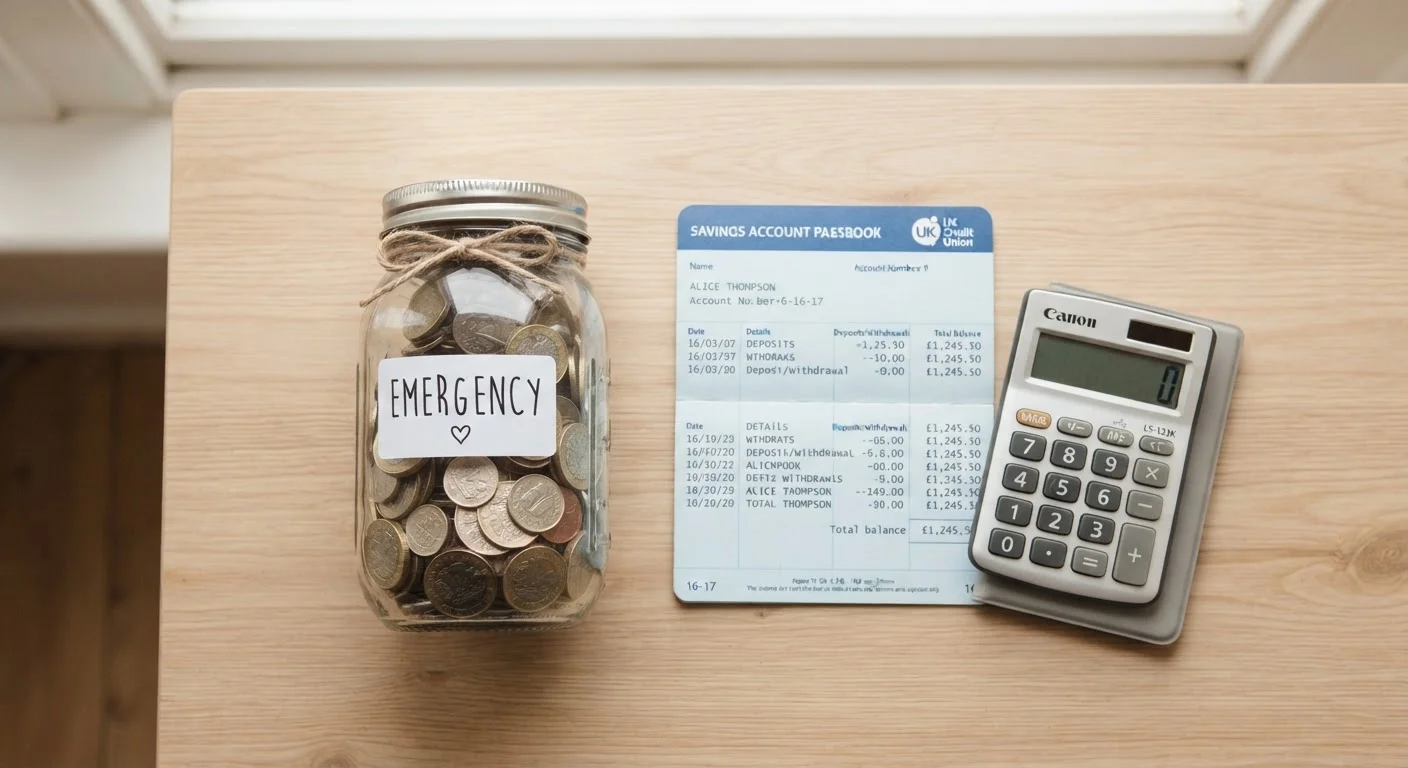
Option A
Emergency Fund
The financial safety net reserved strictly for the unexpected.
Best for: Covering unplanned, urgent expenses like job loss, medical bills, or major home repairs without going into debt.
Option B
Savings Account
The flexible deposit account for accumulating money toward goals.
Best for: Storing money earmarked for planned purchases, vacations, or any financial goal you're actively working toward.
Two Concepts That Are Often Confused
Most Americans have heard that they should have an emergency fund and a savings account — but far fewer understand that these are fundamentally different things. One is a financial product offered by banks; the other is a behavioral strategy for managing risk. Conflating them is one of the most common personal finance mistakes, and it can leave households exposed at exactly the wrong moment.
A savings account is a bank or credit union deposit account that earns interest and keeps money separate from your everyday checking funds. It's a neutral container — it doesn't care what you're saving for. A emergency fund, by contrast, is a deliberate reserve of cash set aside exclusively for genuine financial emergencies: sudden job loss, a major medical expense, an urgent car or home repair. The emergency fund lives somewhere — often a savings account — but its purpose, size, and access rules are what define it.
Understanding this distinction matters because the rules you apply to each are very different. Research on American saving behavior consistently shows that households without clearly defined savings purposes tend to dip into reserves for non-emergencies, eroding the financial buffer they thought they had.
How Each One Works
A savings account functions like a holding account at a bank or credit union. Deposits earn interest — typically expressed as an annual percentage yield (APY) — and the account is federally insured up to $250,000 per depositor through the FDIC (for banks) or NCUA (for credit unions). Savings accounts generally limit certain types of withdrawals per month under federal Regulation D guidelines, though enforcement varies by institution.
An emergency fund operates by a different logic entirely. Financial guidance widely cited by planners and institutions — including the Consumer Financial Protection Bureau — suggests maintaining three to six months' worth of essential living expenses in liquid, easily accessible form. "Essential" here means rent or mortgage, utilities, groceries, and minimum debt payments — not discretionary spending. The fund should only be drawn on for genuine, unplanned crises. It is not a vacation fund, not a down payment account, and not a buffer for overspending.
| Criterion | Emergency Fund | Savings Account |
|---|---|---|
| What it is | A financial strategy / reserve | A bank deposit product |
| Purpose | Cover genuine, unplanned crises | Accumulate money for any goal |
| Recommended size | 3–6 months of essential expenses | Varies by goal |
| Access rules | Touch only in true emergencies | Withdraw as needed for intended goal |
| Where it lives | Usually inside a savings account | At a bank or credit union |
| Earns interest? | Yes, if held in interest-bearing account | Yes, varies by account type |
| Federal insurance | Yes (via FDIC/NCUA on the account) | Yes (FDIC up to $250,000) |
Where the two intersect: an emergency fund is typically stored inside a savings account. Many people use a high-yield savings account for this purpose, since it keeps the money accessible while generating more interest than a standard account. High-yield savings accounts offer advantages, but they also come with trade-offs worth understanding before committing.
Why Keeping Them Separate Matters
The practical problem with combining emergency savings and goal-based savings in a single account is psychological as much as mechanical. When the money is pooled, the boundary between "hands-off" and "available" becomes blurry. A weekend trip, an unexpected sale, or a social occasion can justify a withdrawal that quietly drains what was supposed to be a safety net.
~57%
Americans unable to cover a $1,000 emergency
A Bankrate survey published in early 2024 found that a majority of U.S. adults could not cover an unexpected $1,000 expense from savings alone.
3–6 months
Recommended emergency fund coverage
The Consumer Financial Protection Bureau and most mainstream financial guidance suggest this range of essential monthly expenses as a baseline target.
22%
Adults with no emergency savings at all
The Federal Reserve's 2023 Report on the Economic Well-Being of U.S. Households found roughly one in five adults had set aside no dedicated emergency savings.
Separating accounts — even at the same bank — creates a clear mental and structural barrier. Labeling one account specifically for emergencies and another for named goals ("Italy trip," "new laptop") makes the purpose visible every time you log in. Some banks allow account nicknames precisely because this friction reduces impulsive transfers.
If you're still building your emergency fund from scratch, a structured budgeting approach can help you allocate a consistent portion of income toward it each month. Once the fund is established, automating your contributions reduces the temptation to redirect that money elsewhere.
This article is for general informational purposes only and does not constitute personalized financial, tax, or investment advice. Consult a qualified financial professional for guidance specific to your situation.
The content on this site is for informational purposes only and is not a substitute for professional advice. Always consult a qualified professional for guidance specific to your situation.