

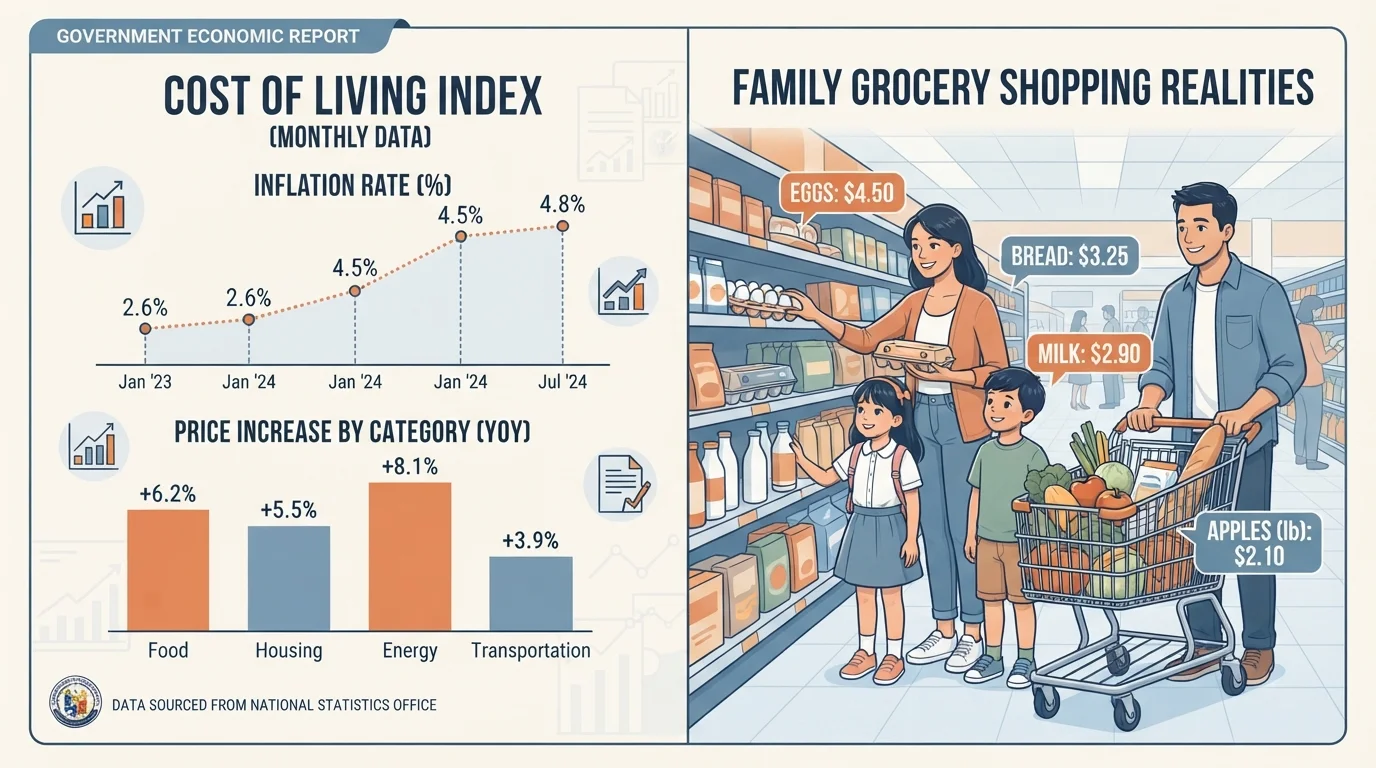
What the CPI Actually Measures
Every month, the Bureau of Labor Statistics sends surveyors to stores, service providers, and online retailers across dozens of U.S. cities to record prices on roughly 80,000 items. Those prices are then weighted and aggregated into the Consumer Price Index — a single number meant to represent how much Americans, on average, are paying for everyday life.
The basket of goods covered includes categories like food, energy, shelter, medical care, apparel, and transportation. Each category is assigned a weight based on how much the average urban household spends on it. Shelter alone accounts for around one-third of the total index weight, reflecting just how significant housing costs are for most Americans.
When the BLS reports that CPI rose 0.3% in a given month, it means that the total cost of that standardized basket increased by that amount compared to the prior month. This figure drives enormous policy decisions — from Federal Reserve interest rate discussions to Social Security cost-of-living adjustments.
~80,000
Prices surveyed monthly for the CPI
According to the U.S. Bureau of Labor Statistics, surveyors collect prices from thousands of retail and service locations across urban areas each month.
~33%
CPI weight assigned to shelter costs
The BLS allocates roughly one-third of the CPI-U basket weight to shelter, making it the single largest component of the index.
2
Primary CPI variants published by BLS
The BLS publishes CPI-U (all urban consumers) and CPI-W (urban wage earners), each using slightly different population samples and weights.
Why Your Personal Inflation Rate May Differ
The CPI's most important limitation is also its most obvious: it measures an average. Averages, by definition, do not describe any specific individual. Your personal "inflation rate" depends almost entirely on what you actually buy and where you live.
Consider two households. One is a retiree couple in a rural Midwestern town who own their home outright and spend heavily on healthcare and prescription drugs. The other is a young renter in Seattle whose budget is dominated by rent and commuting costs. The national CPI will capture neither of their realities accurately, because both households spend very differently from the average urban consumer the CPI is built around.
Geography compounds this further. Housing markets, utility costs, food prices, and local taxes vary substantially from one region to another. A 5% rise in shelter costs means something very different in San Francisco than in Memphis. The CPI does not break out regional cost-of-living differences in the headline figure, though regional data is available in supplementary BLS reports.
The Spending Categories That Distort the Picture
Several categories frequently cause a gap between the official CPI and what individual households feel:
- Healthcare: Medical costs tend to rise faster than overall inflation for many Americans, particularly older adults. The CPI captures out-of-pocket healthcare spending but not the full premium burden absorbed by employers or government programs.
- Childcare and education: Families with young children or college-age dependents often face price increases far above the headline number. These costs are real but have a relatively modest weight in a basket designed to reflect the average household, which may not have children at all.
- Rent vs. ownership: The CPI uses "owners' equivalent rent" — a survey-based estimate of what homeowners would pay to rent their own homes — rather than actual home prices. This can significantly understate the cost burden for people trying to buy a home in an expensive market.
Understanding the economic forces that drive individual prices can help explain why some sectors outpace the broader index by a wide margin.
Build Your Own Household Price Tracker
Consider listing your top five or six monthly expense categories — rent or mortgage, groceries, utilities, transportation, healthcare, and any recurring subscriptions — and track their costs quarter by quarter. Comparing your personal price changes against the published CPI can reveal whether your household is experiencing above- or below-average inflation. This kind of awareness is especially valuable when reviewing your budget or discussing wage expectations.
How to Think About CPI as an Informed Consumer
The CPI remains an indispensable tool for understanding broad economic trends. It informs wage negotiations, government benefit adjustments, and monetary policy. But it is a blunt instrument when applied to any individual's financial life.
A more useful approach is to treat the CPI as background context — a signal of the general direction of prices — while tracking your own household spending separately. Noting which of your regular expenses are rising fastest gives you a personalized inflation picture that no national index can replicate.
This matters especially when making longer-term financial decisions about budgeting, saving, or planning for retirement. A general-audience inflation figure that rises modestly might mask dramatically higher costs in the specific categories that consume most of your income. For decisions tied to your own financial situation, consulting a qualified financial adviser is always advisable.
The CPI is a map of the average American's economic terrain. But your life is not lived on an average map — and knowing the difference helps you navigate it more clearly.
This article is for general informational and educational purposes only and does not constitute personalized financial or investment advice. Readers should consult a qualified financial professional before making decisions based on their individual circumstances.
Frequently Asked Questions
The CPI is published monthly by the U.S. Bureau of Labor Statistics (BLS). The BLS surveys prices for thousands of goods and services across dozens of urban areas to compile the index.
The CPI reflects a national average across a broad range of spending categories. If your personal spending is concentrated in categories rising faster than average — like rent, healthcare, or childcare — your experienced inflation will feel higher than the headline number suggests.
Yes, housing is one of the largest components of the CPI, accounting for roughly one-third of the overall index weight. However, the BLS uses a measure called "owners' equivalent rent" rather than actual home purchase prices, which can understate the cost burden for homebuyers in fast-moving markets.
No. The Federal Reserve often focuses on the Personal Consumption Expenditures (PCE) price index, which uses a different methodology and basket. There are also specialized indexes such as the CPI for the Elderly (CPI-E), designed to better reflect retiree spending patterns.
The CPI provides useful context about broad price trends, but it should not be treated as a precise measure of your personal inflation rate. Tracking your own household expenses over time gives a more accurate picture of how rising prices are affecting your budget.
The content on this site is for informational purposes only and is not a substitute for professional advice. Always consult a qualified professional for guidance specific to your situation.