

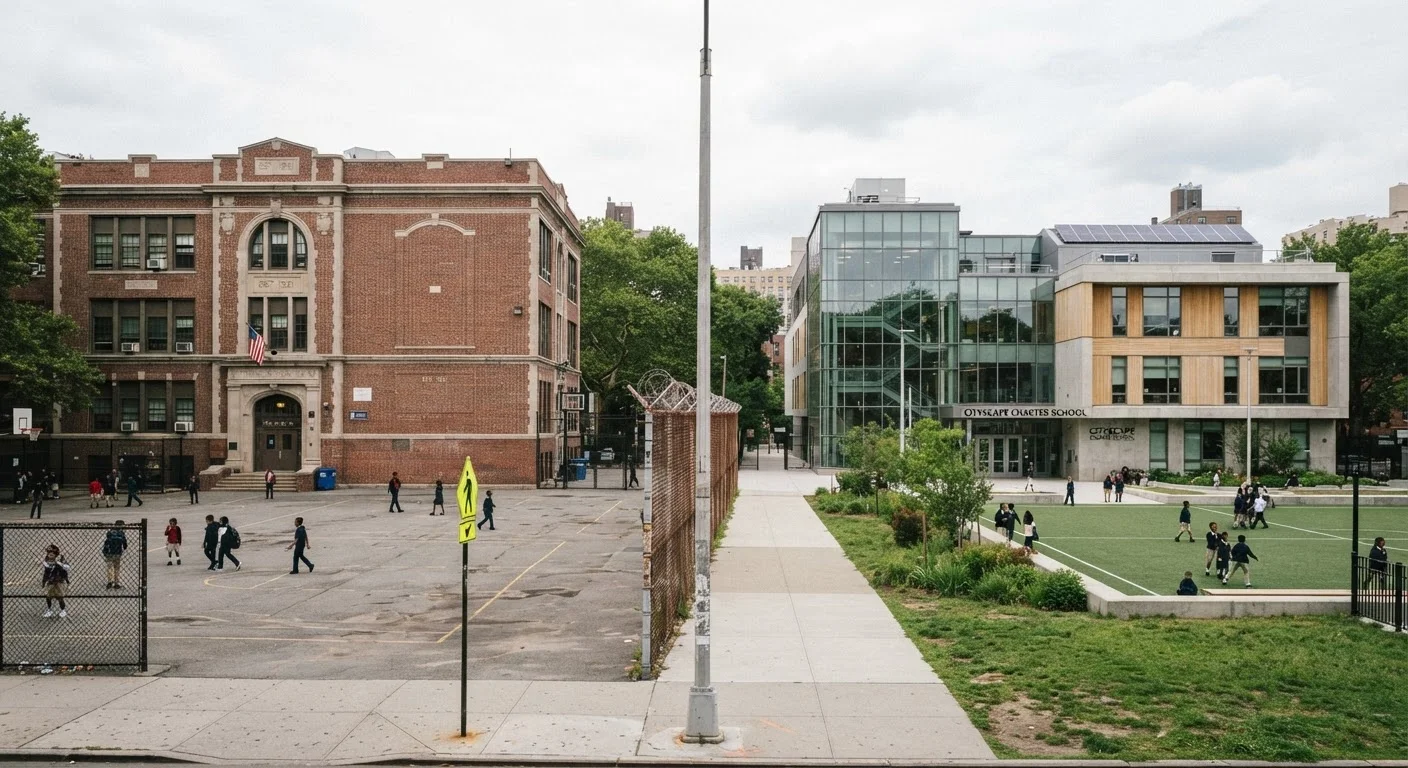
Our Verdict
Neither charter schools nor traditional public schools hold a clear, universal advantage. Charter schools offer autonomy and innovation potential but vary widely in quality and raise legitimate accountability questions. Traditional public schools provide universal access and democratic oversight but can struggle with resource constraints and bureaucratic inertia. The right model depends heavily on local context, specific school quality, and individual student needs.
| Best for | Recommended |
|---|---|
| Families seeking a specialized curriculum or pedagogical approach not available locally | Charter Schools |
| Families prioritizing consistent oversight, democratic accountability, and guaranteed enrollment | Traditional Public Schools |
| Students with disabilities requiring guaranteed legal protections and services | Traditional Public Schools |
| Communities exploring innovation in teaching methods within a public funding framework | Charter Schools |
What Actually Separates These Two School Types
At the most basic level, both charter schools and traditional public schools are funded by taxpayer dollars and are free to attend. The structural difference lies in governance and accountability. A traditional public school is operated directly by a local school district, governed by an elected school board, and subject to the full range of state and district regulations — from hiring practices to curriculum mandates.
A charter school, by contrast, operates under a contract (the "charter") granted by an authorizing body — which may be a school district, a state agency, or a university, depending on the state. That charter grants the school greater operational flexibility in exchange for meeting defined performance benchmarks. If a charter school fails to meet its charter terms, the authorizer can close it — a mechanism that traditional public schools typically don't face.
For a plain-language breakdown of terms that appear frequently in this debate, see our education policy glossary.
| Charter Schools | Traditional Public Schools | |
|---|---|---|
| Governance | Independent operator under charter contract | Elected school board and district administration |
| Funding source | Public per-pupil funds follow the student | District budget from local, state, and federal sources |
| Enrollment | Open application; lottery if oversubscribed | Guaranteed enrollment based on home address |
| Curriculum flexibility | Greater autonomy within state standards | Follows district-mandated curriculum |
| Accountability mechanism | Charter renewal or closure by authorizer | School board oversight and district intervention |
| Special education obligations | Legally required; compliance varies in practice | Legally required; typically more consistent delivery |
| Teacher certification rules | Varies by state; often more flexible | Typically requires state certification |
| Union representation | Less common; varies by school and state | Unionized in most districts |
The Funding Question: Who Gets What
One of the most contested dimensions of this debate is money. When a student enrolls in a charter school, a portion of per-pupil funding follows that student out of the traditional district's budget. Critics argue this drains resources from district schools that still bear fixed costs — building maintenance, transportation infrastructure, and services for students with high needs — even as their enrollment shrinks.
Charter school advocates counter that funding should follow the student, and that families deserve access to public education options beyond their assigned school. They also note that many charter schools receive less per-pupil funding than district schools and often operate without access to facilities funding or bond revenue.
The reality is that funding formulas vary dramatically by state, which means the financial impact of charter enrollment differs enormously depending on where you live. Our article on school funding formulas explains how these allocation mechanisms work in more detail.
3.7M+
Students enrolled in U.S. charter schools
According to the National Alliance for Public Charter Schools, charter school enrollment has grown substantially over the past two decades, representing roughly 7% of U.S. public school students.
7,800+
Charter schools operating nationwide
The National Alliance for Public Charter Schools tracks over 7,800 charter schools operating across 45 states and Washington D.C.
~16%
Charter schools closed for performance failure
Research from the Center on Education Reform has estimated that a significant share of charter schools that have closed did so due to academic or financial performance issues, illustrating how authorizer accountability functions in practice.
Academic Outcomes: What the Research Actually Shows
Headlines tend to cherry-pick data on either side. The honest summary from decades of research is this: outcomes vary widely, and school type alone is a poor predictor of quality. Studies such as Stanford University's Center for Research on Education Outcomes (CREDO) reports have found that charter school performance spans a broad range — some significantly outperform comparable district schools, many perform similarly, and a meaningful share perform worse.
Urban charter schools — particularly those serving low-income students in cities — have shown stronger average results in some large-scale analyses. But rural and suburban charter performance is less consistently positive. Traditional public schools, meanwhile, show their own wide performance variation driven largely by factors like local funding levels, teacher experience, and community demographics rather than governance structure alone.
Because education stories are often framed to support a predetermined conclusion, it's worth reading coverage critically. Our piece on gaps in education reporting offers useful guidance on evaluating sources.
Equity, Access, and Special Education
Access and equity concerns are central to this debate and often underreported. Charter schools use lottery systems when oversubscribed, which introduces an element of chance into school access. Critics argue this creates a two-tier system where engaged, informed families navigate options while others default to under-resourced district schools.
Special education is a specific flashpoint. Traditional public schools are legally required under the Individuals with Disabilities Education Act (IDEA) to provide a free appropriate public education to all students with disabilities. Charter schools, as public schools, are also bound by IDEA, but advocates and researchers have documented inconsistencies in how thoroughly some charter schools fulfill these obligations. Families navigating these rights should review our article on special education rights for a detailed breakdown of legal protections.
Accountability and transparency also differ. School board meetings — open to the public — govern traditional district schools. Many charter management organizations operate with less direct public oversight, though authorizers are supposed to provide a check on performance. For those interested in how community members can engage with public school governance, our guide to navigating a school board meeting is a practical starting point.
How to Evaluate Any School — Charter or Traditional
When assessing a school, look beyond the label. Review publicly available state report cards, ask about student-to-teacher ratios, and request information on how the school serves students with disabilities or English language learners. Visiting the school and speaking with current families provides context that aggregate data cannot. State education department websites publish performance data for both charter and traditional public schools.
The content on this site is for informational purposes only and is not a substitute for professional advice. Always consult a qualified professional for guidance specific to your situation.