

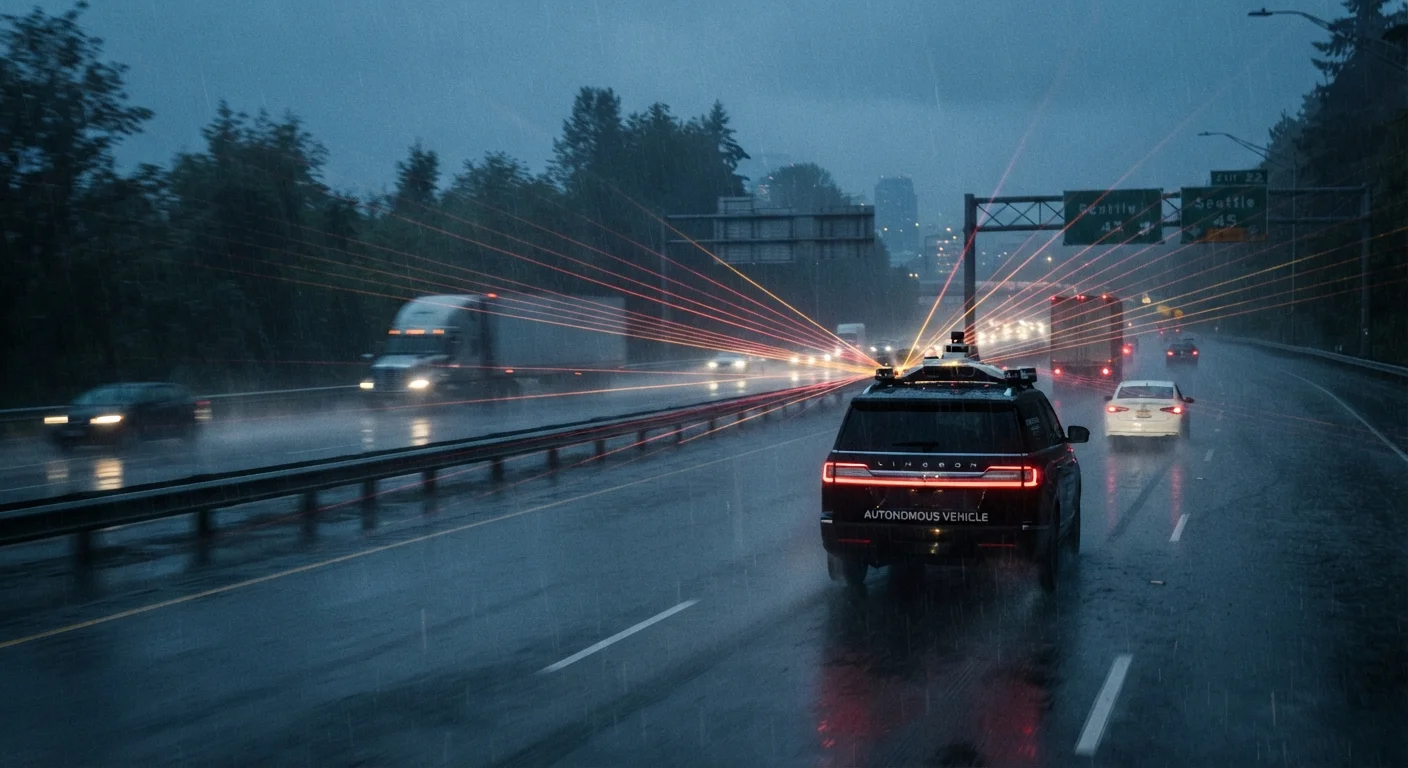
The Core Problem: Sensors Built for Clear Skies
Autonomous vehicles rely on a suite of sensors — primarily lidar, radar, and cameras — to build a real-time picture of the world around them. In dry, well-lit conditions, these systems can perform impressively. But adverse weather introduces physical interference that none of these technologies handles uniformly well.
Lidar, which fires laser pulses to map the environment in three dimensions, is acutely sensitive to water droplets. Rain and fog scatter those pulses before they return cleanly, degrading the point-cloud data the vehicle's software depends on. Cameras face glare from wet road surfaces, reduced contrast in snow, and obscured lane markings. Radar is more weather-resilient than the other two, but it lacks the fine spatial resolution needed to distinguish a pedestrian from a bollard at close range.
The upshot is that each sensor compensates for another's weakness — until bad weather simultaneously degrades multiple systems at once. That overlap is where today's engineering challenge lives. For a broader look at how misconceptions about these systems persist, see this breakdown of self-driving myths.
Assuming lidar alone provides sufficient environmental awareness in all conditions.
Why it happens: Lidar delivers strikingly detailed 3D maps in clear conditions, which can create overconfidence in its all-weather capability during development and testing phases.
Testing autonomous systems primarily in fair-weather environments before deployment.
Why it happens: Fair-weather testing is logistically simpler, cheaper, and produces cleaner data — making it the path of least resistance in early development cycles.
Overlooking road marking degradation as a distinct sensor challenge in winter conditions.
Why it happens: Lane-keeping and localization algorithms are often developed against crisp, high-contrast markings, with road marking deterioration treated as an edge case rather than a regular operating condition.
Relying on GPS-based localization without adequate fallback when signal degrades near dense urban canyons or under heavy cloud cover.
Why it happens: GPS is highly reliable in most conditions, so engineers sometimes underweight the need for redundant localization strategies during initial architecture decisions.
Treating sensor contamination — dirt, ice, and water films on optical surfaces — as a minor maintenance issue rather than a safety-critical design problem.
Why it happens: Contamination effects are easy to observe and clean during controlled testing, so their operational severity in extended real-world use can be underestimated early in the development cycle.
What Engineers Are Doing to Close the Gap
The industry's primary response to weather vulnerability is sensor fusion — combining data streams from multiple sensor types through software that weighs each input according to conditions. When lidar degrades in heavy rain, the algorithm can lean more heavily on radar returns while still extracting usable data from cameras where contrast allows. The challenge is training that arbitration logic to make sound decisions across thousands of weather permutations.
~23%
Lidar range reduction in heavy rain
Research published in transportation engineering journals has found that heavy rainfall can reduce effective lidar detection range by roughly 23% or more, depending on precipitation intensity and droplet size.
70%+
AV test miles logged in fair weather
Analyses of autonomous vehicle testing reports submitted to regulators have noted that the substantial majority of logged miles occur under clear or mild conditions, leaving adverse-weather performance data comparatively sparse.
Beyond software, hardware engineers are tackling sensor contamination directly. Heated lidar housings and camera lens washers — similar in concept to rear-window defrosters — are being integrated into newer prototype designs to keep optical surfaces clear. Some research programs are exploring all-weather lidar wavelengths that scatter less in precipitation, though these remain in early-stage development.
On the AI side, developers are expanding training datasets to include adverse-weather scenarios that were historically underrepresented. Synthetic data generation — using simulation engines to create millions of virtual rainstorms and snowstorms — is accelerating this process without requiring a fleet of test cars to drive through real blizzards. The auto industry news landscape reflects growing investment in this area across both established automakers and technology-focused mobility startups.
Regulatory bodies are also beginning to grapple with these limitations. Standards for how autonomous systems must behave when sensor confidence drops — sometimes called operational design domain (ODD) requirements — are increasingly central to certification discussions worldwide. For the full policy picture, see what regulators around the world are saying about self-driving cars.
Operational Design Domains Are Not Universal
When an autonomous vehicle is approved for public road use, that approval is typically bounded by specific conditions — geography, speed, weather, and time of day — known as its operational design domain. A system cleared for operation in a mild-climate city is not automatically safe or legal to operate in a northern winter environment. Consumers and fleet operators should scrutinize ODD restrictions carefully before assuming any autonomous system is all-weather capable.
Progress is real, but it is measured. Most commercial autonomous deployments today are deliberately confined to geographies with mild, predictable weather — a practical acknowledgment that the engineering gaps identified here have not yet been fully closed.
The content on this site is for informational purposes only and is not a substitute for professional advice. Always consult a qualified professional for guidance specific to your situation.