

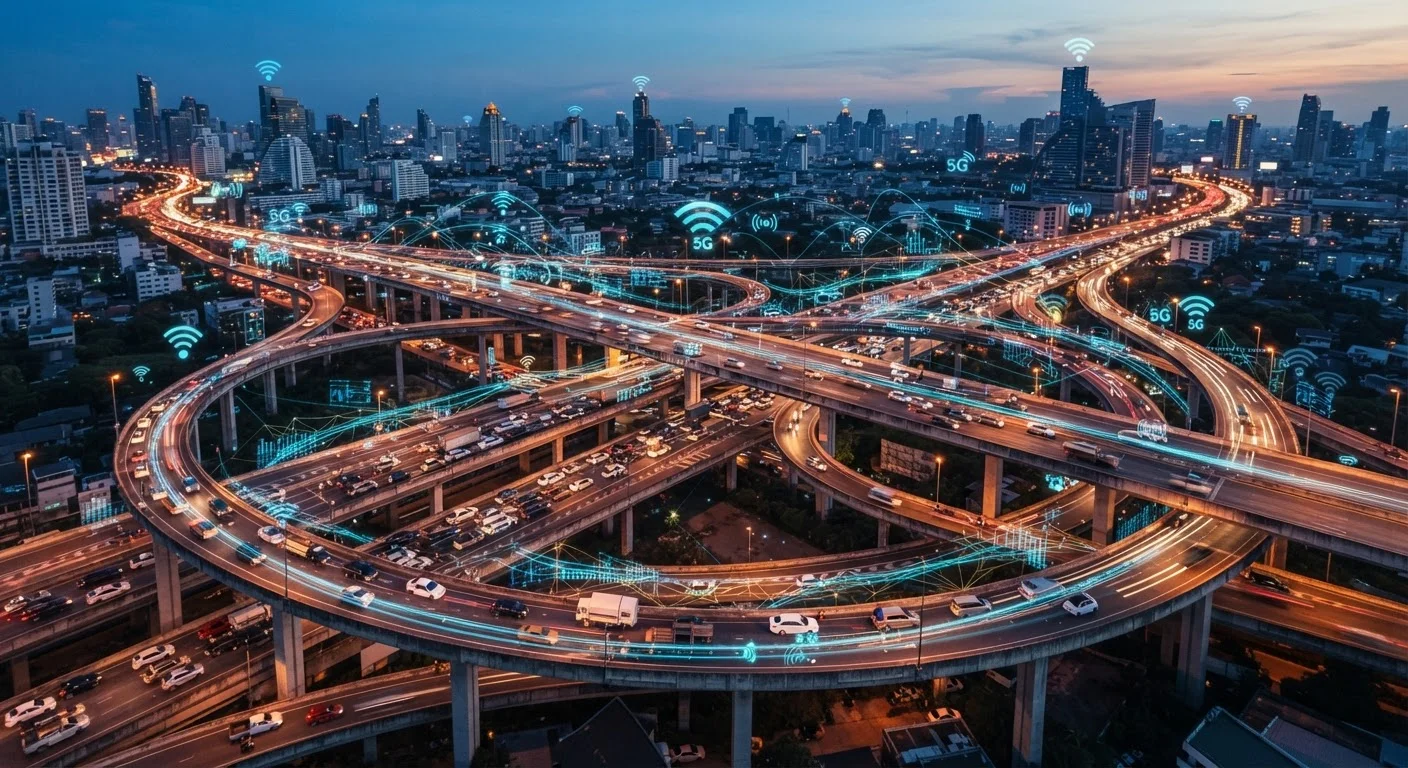
What V2X Communication Actually Does
At its core, V2X communication turns each vehicle into a node — a point in a broader data network. Rather than relying solely on what its own cameras and radar can detect, a connected vehicle continuously broadcasts its position, speed, and direction while receiving equivalent data from surrounding vehicles and roadside units. The result is a cooperative awareness that extends far beyond any single vehicle's line of sight.
Consider a practical scenario: a delivery truck runs a red light at an intersection you are approaching. Your onboard sensors cannot see the truck because a building is in the way — but a V2I (Vehicle-to-Infrastructure) system can. A sensor embedded in the intersection detects the violation and transmits a warning to approaching vehicles within milliseconds, giving drivers time to brake before a collision occurs.
This is the fundamental promise of V2X: not just smarter cars, but a smarter road system. The technology is increasingly considered a complement to — rather than a replacement for — the sensor suites described in articles like our explainer on autonomous vehicle technology.
~38,000
U.S. traffic fatalities in a recent year
The National Highway Traffic Safety Administration (NHTSA) has cited V2X as a technology with potential to address a significant share of crashes involving human error at intersections and in merging scenarios.
5.9 GHz
Spectrum band designated for vehicle safety
The FCC originally reserved this band exclusively for DSRC-based vehicle safety communications in 1999; a 2020 reallocation opened most of it to other uses, reshaping U.S. V2X policy direction.
Millions
Roadside units needed for national V2X coverage
The U.S. Department of Transportation has estimated that full corridor-level V2X deployment would require equipping hundreds of thousands of intersections and highway segments with connected infrastructure hardware.
The Two Competing Standards: DSRC vs. C-V2X
A significant part of the V2X story in the United States involves a long-running technical and regulatory debate between two radio communication standards.
DSRC (Dedicated Short-Range Communications) uses a slice of the 5.9 GHz spectrum that the Federal Communications Commission set aside for vehicle safety use in 1999. It is a Wi-Fi-adjacent technology designed specifically for low-latency, direct vehicle-to-vehicle and vehicle-to-infrastructure messaging without needing a cellular tower as an intermediary.
C-V2X (Cellular V2X), backed heavily by chipmakers and telecom companies, uses cellular network infrastructure — including 4G LTE and 5G — to relay messages. It offers potentially greater range for some applications and integrates more naturally with the cloud-based services automakers are building into modern vehicles.
In 2020, the FCC reallocated much of the 5.9 GHz band away from DSRC, dealing a significant blow to that standard's future in the U.S. The decision effectively tilted domestic policy momentum toward C-V2X, though the debate over spectrum, standards, and rollout funding continues among automakers, regulators, and municipalities.
The DSRC vs. C-V2X Decision Is Not Fully Settled
While U.S. spectrum policy has moved away from DSRC, some existing deployments and international markets (particularly in Europe and Japan) continue to invest in DSRC-based systems. Automakers selling vehicles globally may support multiple standards. The long-term picture will depend on regulatory decisions, infrastructure funding, and which standard achieves the critical mass of deployment needed to generate network benefits.
Safety Applications: Where V2X Has the Most Immediate Impact
The clearest near-term value of V2X lies in safety use cases that address the limits of what onboard sensors alone can achieve. Several categories stand out:
- Intersection collision warnings: Alerts when another vehicle is likely to run a red light or enter an intersection at the same time from a perpendicular direction.
- Emergency vehicle alerts: Notifications when an ambulance or fire truck is approaching — even before drivers can hear a siren.
- Wrong-way driver detection: Highway infrastructure can detect and broadcast wrong-way vehicle warnings to approaching drivers within seconds.
- Curve speed warnings: Roadside units in sharp curves can alert drivers if their speed is unsafe for current road conditions.
- Work zone protection: Connected signs and barriers can broadcast real-time lane closure information directly into the vehicle.
These applications do not require a vehicle to be autonomous to deliver value — they work with attentive human drivers and driver-assistance systems alike. That distinction matters: V2X safety benefits can, in principle, reach mainstream consumers years before full self-driving technology is commercially widespread.
Traffic Flow and the Network Effect
Beyond individual safety warnings, V2X enables what transportation engineers call cooperative traffic management. When vehicles and signals share data continuously, the network can smooth traffic flow in ways no single driver or signal controller could achieve independently.
One well-documented application is signal phase and timing (SPaT) data, where traffic signals broadcast their current state and upcoming phase changes to approaching vehicles. A vehicle receiving SPaT data can advise a driver on the optimal speed to reach the next green light — reducing stop-and-go cycles that waste fuel and increase emissions. At scale, coordinated SPaT systems have shown potential to meaningfully reduce intersection delay and idling time in research pilots, though real-world results depend heavily on local infrastructure investment and traffic density.
This infrastructure dimension is central to the broader urban mobility picture. Cities redesigning streets for new mobility technologies are increasingly factoring V2X readiness into their planning, recognizing that the benefits of connected vehicles scale with the number of participants in the network — vehicles and roadside units alike.
Barriers to Widespread Adoption
V2X technology faces a classic network-effect challenge: its safety and efficiency benefits grow substantially as more vehicles and more infrastructure become connected. A lone connected car on a road with no V2X-equipped signals or other vehicles receives very little benefit. Deployment requires parallel investment from automakers, municipalities, and state transportation agencies — a coordination challenge that has slowed progress.
Cost is a related barrier. Equipping roadside infrastructure — thousands of intersections, highway ramps, and work zones — with V2X units requires capital that many municipalities and state DOTs are still working to secure. Federal infrastructure funding programs have allocated resources toward connected vehicle pilots, but full national deployment remains a long-term project rather than an imminent reality.
Consumers evaluating connected vehicle claims in the meantime would benefit from the critical framework outlined in our guide to following auto industry news responsibly — distinguishing between pilot programs, announced commitments, and features available in production vehicles today is essential context.
Privacy and cybersecurity concerns also require ongoing attention. While V2X safety messages are designed to be anonymous at the protocol level, the broader ecosystem of connected vehicle data — gathered by manufacturers, insurers, and third-party apps — raises legitimate questions about data governance that regulators and industry are still working through.
Frequently Asked Questions
V2X stands for Vehicle-to-Everything, a set of wireless technologies that let cars share data with other vehicles, traffic lights, road sensors, and mobile networks. Think of it as giving every vehicle — and the road system itself — a common language for exchanging safety and traffic information in real time.
Not necessarily. Some V2X communication runs on dedicated short-range radio frequencies that operate independently of cellular networks. However, newer C-V2X systems can leverage 4G LTE and 5G infrastructure to extend range and enable cloud-based traffic management features.
No. A connected car exchanges data with its environment but is still controlled by a human driver. A self-driving car uses onboard sensors and software to operate without driver input. The two technologies are complementary — autonomous vehicles benefit significantly from V2X data — but they are not the same thing.
V2X is already present in some production vehicles and pilot programs across U.S. cities, but broad deployment depends on simultaneous investment in both vehicle hardware and roadside infrastructure. Industry analysts generally expect gradual rollout through the late 2020s, though timelines vary by region and regulatory decisions.
Cybersecurity is an active area of concern and research. V2X standards incorporate cryptographic authentication to verify message sources, but no connected system is entirely immune to attack. Automakers and standards bodies are continuously working on security protocols to reduce vulnerabilities.
V2X safety messages are generally designed to transmit location and motion data without identifying individual drivers. However, privacy policies vary by application and manufacturer, and regulatory frameworks around data retention are still evolving. Readers should review their vehicle's privacy documentation for specifics.
The content on this site is for informational purposes only and is not a substitute for professional advice. Always consult a qualified professional for guidance specific to your situation.