

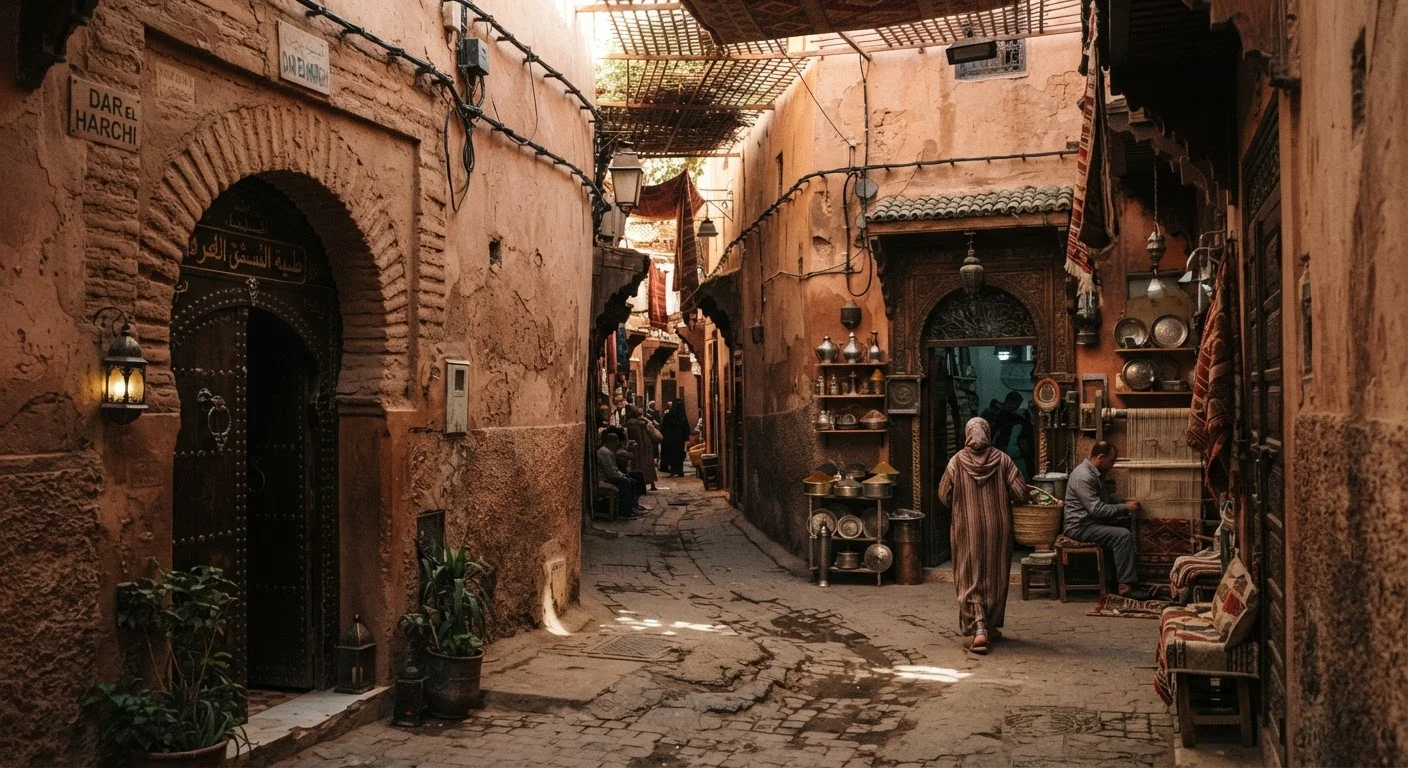
Why Medinas Feel Disorienting — and Why That's By Design
Morocco's historic medinas — the walled old cities of Fez, Marrakech, Meknes, and others — predate the automobile by many centuries. Their layouts evolved organically over hundreds of years, shaped by trade routes, clan neighborhoods (called derbs), craft guild territories, and defensive considerations rather than any urban planning grid.
The result is a dense web of passages that narrow, fork unexpectedly, dead-end, and loop back on themselves. Streets are rarely named consistently, and the same alley may be known by two or three different local names. Even experienced travelers describe Fez el-Bali — the oldest and largest medieval medina in the world — as genuinely difficult to navigate without preparation.
Understanding this structure is the first practical step. The medina is not chaotic by accident; it is ordered around a logic of zones. Mosques and Quranic schools (madrasas) anchor religious districts. The central souks — covered market streets — radiate outward from these anchors, typically organized by trade: leather goods in one lane, spices in another, metalworkers in a third. Residential derbs branch off from the commercial arteries into quieter dead-end alleys. Recognizing these zones helps orient movement even without a precise map. For broader travel planning strategies, contextualizing a destination's layout before arrival consistently reduces on-the-ground confusion.
What to Prepare Before You Enter
Preparation done outside the medina walls saves significant time and stress inside them.
What you will need
Offline map application
Provides navigation without requiring a live data connection inside the medina.
Licensed local guide
Provides expert orientation, especially valuable for a first visit to Fez el-Bali.
Small printed map or hand-drawn sketch
Backup navigation reference when phone battery is low or signal is fully absent.
Study a map of the medina before arrival — not to memorize every alley, but to identify two or three major landmarks and the general direction of your accommodation relative to the main gates. Most medinas have one or two principal entry gates (babs) that serve as reliable orientation anchors.
Step-by-Step: Moving Through a Medina Confidently
The following steps apply across Morocco's main medinas, though Fez el-Bali warrants particular caution given its scale — it contains an estimated 9,000 streets and lanes.
Identify your anchor landmarks before entering
Before passing through any medina gate, note two fixed landmarks: the one closest to your accommodation and the one closest to the area you intend to visit. Large mosques, the central covered souk, and main city gates are reliable anchors that locals can point you back toward at any time.
Navigate by zone, not by street name
Rather than trying to follow street-by-street directions, move through the medina by zone — from the gate toward the main souk, then from the souk toward the mosque quarter, then outward toward residential areas. Street names, where they exist, are often inconsistently marked or posted only in Arabic.
Track direction using sound and foot traffic
Inside the medina, ambient cues provide reliable directional signals. The call to prayer echoes from the main mosque and indicates a central area. Increasing noise, cooking smells, and pedestrian density typically signal movement toward the commercial souk. Quiet, narrowing lanes with fewer people generally indicate movement toward a residential dead end.
Ask for directions using landmarks, not addresses
When asking locals for directions, use landmark names rather than street names or addresses. Phrasing a request as "Which way to the Koutoubia?" (in Marrakech) or "Where is the Bou Inania Madrasa?" (in Fez) will be understood far more reliably than any street-level address. Learning the Darija words for "straight ahead" (nishan), "left" (lissar), and "right" (limine) helps interpret responses.
Reorient at open spaces
Whenever you reach a small plaza, fountain square, or open intersection, pause and cross-reference your offline map. These open nodes appear at intervals throughout medinas and offer the clearest GPS readings available — the open sky improves satellite lock. Use them deliberately as checkpoints rather than passing through without looking.
Common Pitfalls and How to Handle Them
Even well-prepared travelers encounter moments of genuine confusion. A few recurring situations are worth anticipating.
Unsolicited guides: In Marrakech and Fez, visitors are sometimes approached by individuals offering to lead them to their destination, occasionally for a fee or with a stop at a family shop. This practice has decreased since Morocco formalized its licensed guide system, but it still occurs. Politely declining and continuing confidently — even if you are uncertain — is generally the most effective response.
Dead ends: Dead-end derbs are residential areas, not public thoroughfares. If you find yourself in a quiet alley with a cluster of private doors and no exit, retrace your steps without entering courtyards or doorways.
Signal loss: Expect intermittent or absent mobile data inside densely packed medina corridors. This is where offline maps downloaded in advance become critical rather than optional.
When to Hire a Licensed Guide
Morocco's government operates an official licensed guide system through local tourism offices. For first-time visitors to Fez el-Bali in particular, a half-day with a licensed guide is broadly considered worthwhile — not just for navigation but for understanding the medina's historical layers. Guides can be arranged through official tourism offices, most riads, and accredited agencies. Verify licensing credentials before agreeing to any arrangement.
If genuinely lost, the most reliable strategy is to ask any shopkeeper to point you toward the nearest large mosque or the main souk. These are landmarks that locals can always direct you to, and from those anchors you can reorient using your map.
The content on this site is for informational purposes only and is not a substitute for professional advice. Always consult a qualified professional for guidance specific to your situation.