

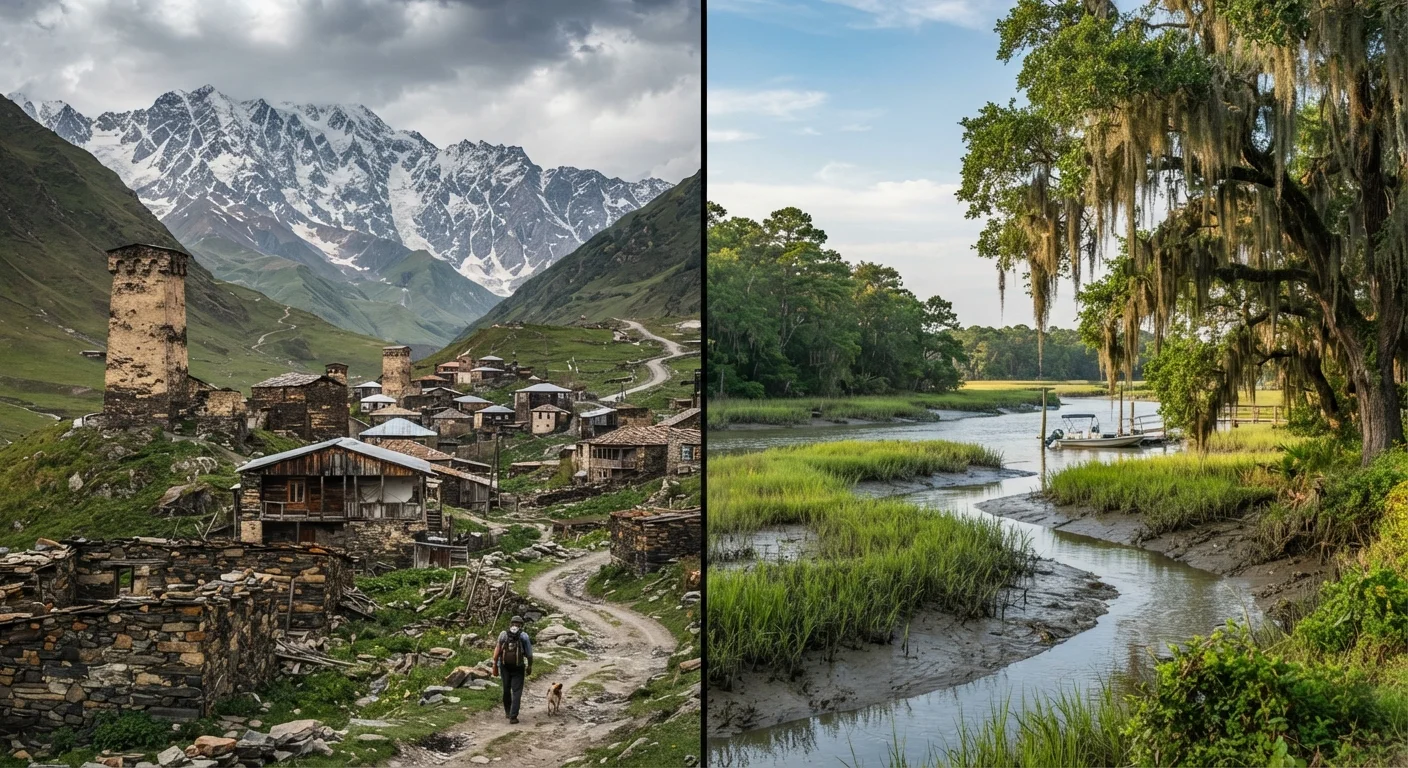
Option A
Georgia (the Country)
The ancient Caucasus crossroads of culture, wine, and mountain wilderness.
Best for: Travelers drawn to off-the-beaten-path history, UNESCO-listed cave cities, and some of the world's oldest winemaking traditions.
Option B
Georgia (the U.S. State)
The American South's diverse gateway of coastal beauty, mountain trails, and historical depth.
Best for: Visitors seeking Southern cultural heritage, Appalachian trail access, barrier island escapes, and vibrant urban food scenes.
Geography and Setting: Mountains, Marshes, and Everything Between
The Republic of Georgia occupies roughly 26,900 square miles in the South Caucasus, bordered by Russia to the north, Turkey and Armenia to the south, and Azerbaijan to the east. Its terrain shifts from snowcapped Greater Caucasus peaks — including Mount Shkhara, which tops 17,000 feet — down through forested valleys to the subtropical Black Sea coast. The country's compact size means travelers can move from alpine landscapes to ancient lowland cities within hours.
The U.S. state of Georgia, at around 59,000 square miles, is the largest state east of the Mississippi River. Its northern edge rises into the Blue Ridge Mountains, home to sections of the Appalachian Trail. The Piedmont plateau occupies the central region, while the coastal plain extends south toward the Okefenokee Swamp and the Atlantic barrier islands known as the Golden Isles. Atlanta, the state capital, sits near the geographic center and functions as a major international aviation hub.
| Criterion | Georgia (Country) | Georgia (U.S. State) |
|---|---|---|
| Location | South Caucasus, between Europe and Asia | Southeastern United States |
| Size | ~26,900 sq miles | ~59,000 sq miles |
| Capital | Tbilisi | Atlanta |
| Language | Georgian (unique alphabet) | English |
| Currency | Georgian lari | U.S. dollar |
| Signature landscape | Greater Caucasus peaks and Black Sea coast | Blue Ridge Mountains and Atlantic barrier islands |
| Standout cultural draw | 8,000-year-old winemaking tradition | Civil rights history and Gullah Geechee heritage |
| Visa for U.S. citizens | Currently visa-free (verify before travel) | No passport required |
History and Culture: Ancient Crossroads vs. the American South
The Republic of Georgia is one of the world's earliest Christian nations, adopting Christianity as its state religion in the early 4th century. Its landscape is layered with evidence of successive civilizations — Colchian, Greek, Persian, Roman, Byzantine, Mongol, and Ottoman influences all left their mark. The cave city of Vardzia, carved into a volcanic cliff in the 12th century, and the hilltop church of Gergeti Trinity near the town of Stepantsminda are among the most visited historical sites. UNESCO has recognized several Georgian cultural landscapes and polyphonic singing traditions as part of the world's intangible heritage.
U.S. Georgia carries the complex and often difficult history of the American South. It was one of the original 13 colonies, a central site of the Civil War, and a birthplace of the American civil rights movement — Atlanta's Martin Luther King Jr. National Historical Park draws hundreds of thousands of visitors annually. Savannah's 22 historic squares represent one of the best-preserved examples of 18th-century urban planning in the United States. The state's African American heritage, including Gullah Geechee culture along the coast, adds another dimension that is increasingly recognized in regional tourism programming.
8,000
Years of winemaking history in the Caucasus
Archaeological evidence from the South Caucasus region, including Georgia, suggests wine production dates back approximately 8,000 years, making it one of the oldest known winemaking cultures.
4th century
When Georgia adopted Christianity as state religion
The Republic of Georgia is recognized as one of the world's first nations to adopt Christianity officially, in the early 300s CE.
Top 20
Busiest airport globally — Hartsfield-Jackson Atlanta
Hartsfield-Jackson Atlanta International Airport consistently ranks among the world's busiest airports by passenger traffic, according to Airports Council International data.
Practical Travel Considerations
Reaching the Republic of Georgia from the United States typically involves connecting flights through European hubs, with total travel times often exceeding 14 hours. U.S. citizens can currently enter Georgia visa-free for stays up to one year, though travelers should verify current entry conditions through the U.S. Department of State and official Georgian government sources before booking. The local currency is the Georgian lari, and while English is spoken in tourist areas, learning a few words of Georgian is appreciated. The country uses its own unique alphabet, which can make independent navigation more challenging in rural regions.
Traveling within U.S. Georgia is straightforward for American residents. Hartsfield-Jackson Atlanta International Airport is one of the busiest in the world, providing easy access. Driving is the dominant mode of travel for exploring the state's diverse regions. Coastal areas, particularly the Golden Isles and Savannah, draw heaviest crowds in spring and fall; mountain areas like Blue Ridge and Dahlonega peak in autumn foliage season. Summers are hot and humid statewide, which is a practical consideration for outdoor itineraries.
Entry requirements, travel advisories, and visa rules change frequently. Always consult official government sources — including travel.state.gov for U.S. travelers going abroad — before making international travel plans.
The content on this site is for informational purposes only and is not a substitute for professional advice. Always consult a qualified professional for guidance specific to your situation.