

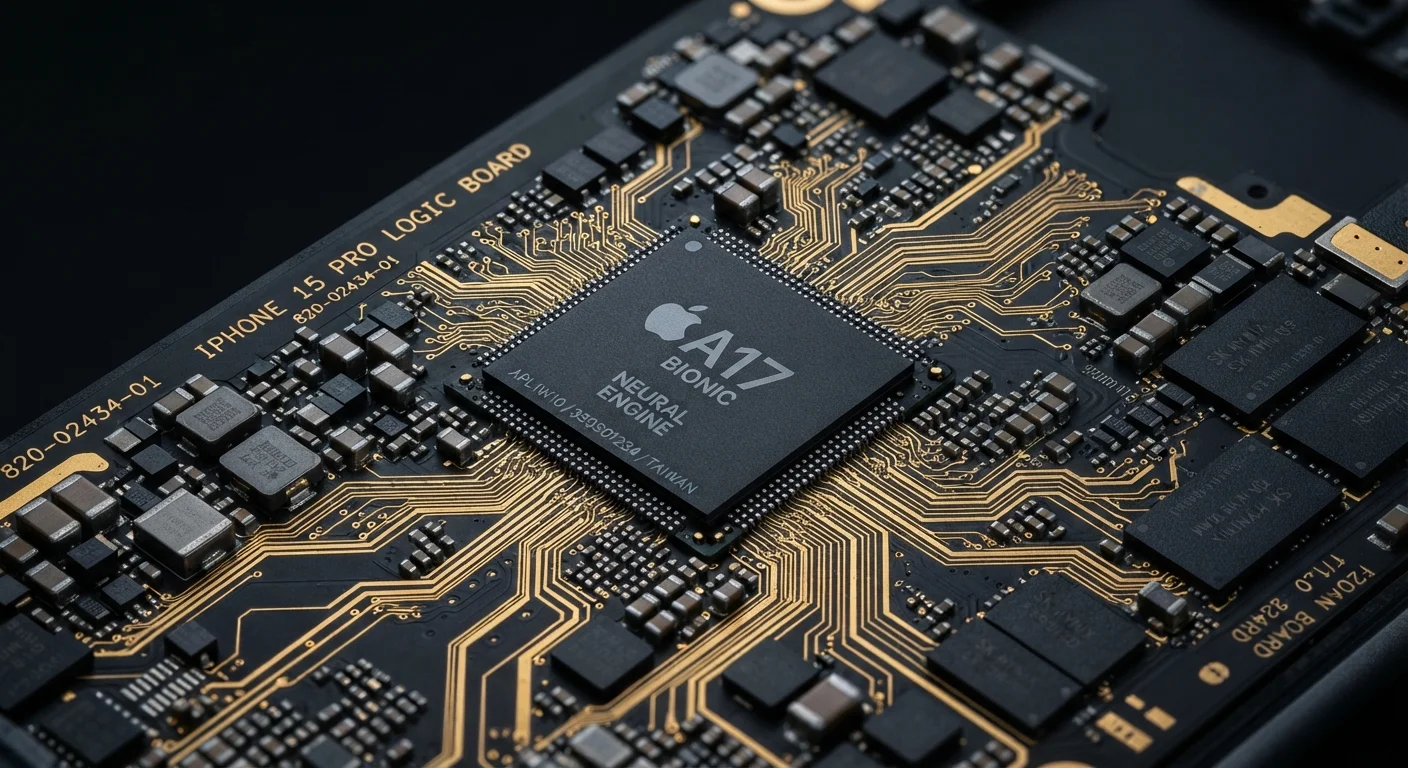
The Chip Behind Everything Your Phone Does
Every time you launch an app, snap a photo, stream a video, or ask a voice assistant a question, you're relying on your phone's system-on-chip. The SoC is the component that makes all of this possible — and it does it in a package smaller than your thumbnail.
Before SoCs became standard, mobile devices used multiple discrete chips for different jobs: one for processing, one for graphics, one for wireless radios. That approach consumed more power and required more physical space. The move to a unified chip changed everything, enabling the slim, powerful devices consumers carry today.
~16 billion
Transistors in a modern flagship smartphone SoC
Leading chip designers have publicly disclosed transistor counts for their flagship mobile processors, with recent generations exceeding 16 billion transistors on a single die.
3nm
Process node used in latest-generation mobile chips
Several major mobile SoC makers have moved production to 3-nanometer process nodes, enabling significant efficiency and density improvements over prior generations.
~40%
Portion of smartphone cost attributable to silicon
Industry analyses have consistently found that the SoC and memory components together represent a substantial share of a smartphone's total bill of materials.
What's Actually Inside an SoC
An SoC is made up of several distinct functional blocks, each optimized for a specific job:
- CPU (Central Processing Unit): Handles general-purpose computing tasks — the logic powering your apps and operating system. Modern SoCs include multiple CPU cores designed for different performance and efficiency trade-offs.
- GPU (Graphics Processing Unit): Renders visual content, from the user interface to gaming graphics. A powerful GPU is what makes high-refresh-rate displays and graphically intensive games feel smooth.
- NPU or Neural Engine: A dedicated block for artificial intelligence and machine learning tasks. This is what enables real-time photo enhancement, voice recognition, and predictive text without needing to send data to a remote server.
- Modem: Manages wireless connectivity, including 5G, LTE, and Wi-Fi. The modem's capabilities determine what network speeds your phone can actually reach.
- ISP (Image Signal Processor): Processes raw data from your camera sensors, handling noise reduction, color science, and computational photography in real time.
These components share resources and communicate at extremely high speeds precisely because they exist on the same piece of silicon.
Why SoC Design Shapes Your Daily Experience
The SoC is arguably the single most consequential decision in a smartphone's design. It sets a hard ceiling on what the device can do — no amount of software updates can make a weak chip perform like a powerful one.
Consider camera performance. The quality of your photos isn't purely about the camera lens; the ISP and NPU within the SoC determine how intelligently the phone processes light, handles moving subjects, and applies computational enhancements. A more capable SoC can run more sophisticated algorithms, producing noticeably better results in low light or fast-action scenes.
Battery life follows the same logic. A chip manufactured on a more advanced process node completes tasks more efficiently, leaving more battery capacity for the hours ahead. Gaming, video calls, and navigation all stress the CPU and GPU simultaneously — how well the SoC manages that load without overheating or throttling defines the real-world experience.
“The silicon inside a smartphone is no longer just a processor — it's the platform. Everything from camera intelligence to battery endurance flows from what that chip can do.”
— Jim Keller, Veteran chip architect with decades of experience designing processors for major technology companies
AI features represent the newest frontier. On-device processing — where tasks like translation, photo recognition, or dictation happen locally rather than in the cloud — requires a capable NPU. The SoC you're carrying today was designed with those workloads in mind years before it shipped.
What This Means When You're Evaluating a Phone
Understanding SoCs doesn't require a degree in electrical engineering. What matters practically is knowing that chip generation, process node, and the balance of CPU, GPU, and NPU cores all translate to real differences in speed, efficiency, and feature support.
A phone released with a cutting-edge SoC is more likely to receive software support for longer, handle demanding apps for more years without slowing down, and support newer connectivity standards like Wi-Fi 7 or advanced 5G bands as they roll out.
When reading phone specifications, the SoC name and generation are among the most meaningful numbers on the sheet — more so than marketing terms like "AI-enhanced" or "pro-grade." Those features are only as capable as the chip underneath them.
The system-on-chip is, in many ways, the most honest indicator of a phone's true capability — and understanding it gives consumers a clearer lens for comparing devices on terms that actually matter.
Frequently Asked Questions
An SoC serves as the central nervous system of your phone. It handles every major computing task — running apps, rendering graphics, processing photos, managing wireless connections, and increasingly, executing on-device AI tasks. Because all these functions share one chip, they communicate faster and consume less power than if they were handled by separate components.
A traditional CPU (central processing unit) handles general computation, but it's just one piece of the puzzle. An SoC integrates a CPU alongside a GPU, modem, neural processing unit, image signal processor, and more — all on one piece of silicon. Think of a CPU as one department in a building, while the SoC is the entire office complex.
Yes, significantly. A more efficient SoC accomplishes the same tasks while drawing less electrical power, which extends the time between charges. The manufacturing process node plays a major role here — chips built on smaller nodes pack more transistors into less space and generally run cooler and more efficiently.
No. Unlike desktop computers where processors can sometimes be swapped out, the SoC in a smartphone is permanently integrated into the device's motherboard. Choosing a phone means choosing its SoC for the device's entire lifespan, which is why the chip inside is worth paying attention to when evaluating a new phone.
The SoC is a major factor. Two phones at the same price point can behave very differently if one uses a more capable or more efficiently designed chip. Software optimization also plays a role, but raw chip architecture sets the ceiling for what a device can actually do.
The content on this site is for informational purposes only and is not a substitute for professional advice. Always consult a qualified professional for guidance specific to your situation.