

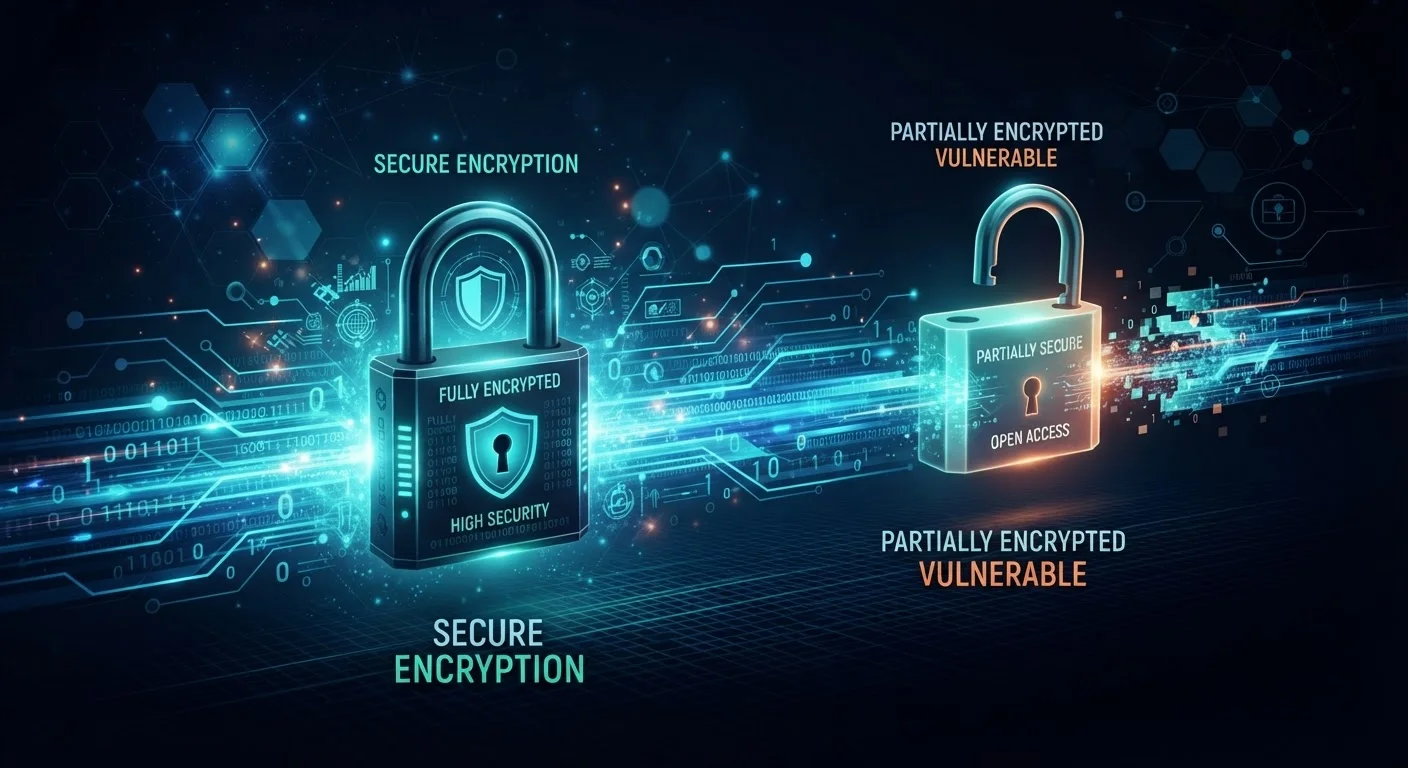
Option A
End-to-End Encryption (E2EE)
The gold standard for private communication.
Best for: Anyone who needs assurance that only the sender and recipient can read a message — including journalists, activists, and privacy-conscious everyday users.
Option B
Standard Encryption (In-Transit / At-Rest)
Reliable baseline protection for most online services.
Best for: General web browsing, cloud storage, and business services where the provider needs access to content for functionality or legal compliance.
What Each Type of Encryption Actually Does
Encryption converts readable data into a scrambled format that only authorized parties can decode. But that broad definition masks a critical difference: who holds the keys.
Standard encryption — commonly called encryption in transit (via TLS/HTTPS) or encryption at rest — protects data as it travels across a network or sits on a server. The service provider manages the decryption keys, which means they can unlock your data when needed. That's how your email provider can search your inbox, how a cloud service can generate thumbnail previews, and how platforms can comply with legal data requests.
End-to-end encryption (E2EE) goes further. The data is encrypted on the sender's device and can only be decrypted on the recipient's device. The service provider transmits the encrypted content but never holds the keys to open it. Not even a subpoena to the provider yields readable content — because the provider simply doesn't have it.
Understanding this distinction is foundational to reading privacy claims critically. For a broader vocabulary of security concepts, see common cybersecurity terms explained.
Head-to-Head Comparison
The table below illustrates how the two approaches differ across the factors that matter most to everyday users.
| Criterion | End-to-End Encryption | Standard Encryption |
|---|---|---|
| Who holds decryption keys | Only sender & recipient | Service provider |
| Provider access to content | None | Yes, when needed |
| Protection against provider breach | High — content unreadable | Lower — keys may be exposed |
| Server-side search or indexing | Not possible | Supported |
| Legal / compliance data access | Provider cannot comply | Provider can produce data |
| Account recovery options | Limited or none | Typically available |
| Common examples | Signal, some iMessage modes | HTTPS, most cloud email |
One practical implication: when a messaging app says it uses encryption, that claim alone doesn't confirm E2EE. Look specifically for the phrase "end-to-end encrypted" and check whether it applies by default or only when manually enabled.
Where Each Type Appears in Daily Life
Standard encryption is the baseline of the modern web. Every time your browser shows a padlock icon and an HTTPS address, TLS encryption is protecting data in transit between your device and a server. Most cloud email services, banking portals, and e-commerce platforms rely on this model.
E2EE is less universal but increasingly common in messaging. Apps such as Signal use it by default across all messages and calls. Some other messaging platforms implement E2EE selectively — for certain conversation types but not group chats, or only when both parties use a specific mode.
~2 billion
WhatsApp users under default E2EE
WhatsApp has reported approximately 2 billion users globally, with end-to-end encryption applied to messages by default since 2016.
95%+
Web traffic encrypted via HTTPS
Google's Transparency Report has consistently shown that over 95% of pages loaded in Chrome use HTTPS encryption.
Cloud storage presents a more nuanced picture. Most major providers encrypt your files, but they retain the keys — meaning they can access content for moderation, legal requests, or account recovery. A smaller category of "zero-knowledge" cloud services extends E2EE principles to stored files, though these typically sacrifice some convenience features as a result.
It's also worth noting that encryption — of either type — protects data in motion or at rest, not necessarily on the device itself. If a phone is unlocked and an app is open, the messages on screen are readable regardless of how they were transmitted. This is one of several reasons why common privacy beliefs deserve scrutiny.
Trade-Offs Worth Knowing
E2EE's strength is also its limitation. Because the provider can't access content, certain features become impossible: server-side search of message history, automatic content moderation, and account recovery if a device is lost. For some users, those trade-offs are worthwhile. For others — particularly businesses with compliance requirements — standard encryption provides the functionality they need while still defending against outside attackers.
Neither approach is universally superior. The right model depends on the threat a user is protecting against and the functionality they require. Someone sharing sensitive legal or medical information may prioritize E2EE above convenience. A person using a work email platform governed by corporate policy may have no choice — and may not need the added restriction E2EE imposes.
What matters most is understanding the difference well enough to read privacy disclosures accurately, ask informed questions, and calibrate expectations — rather than assuming all encryption offers the same level of protection.
This article is for general informational and educational purposes only. It does not constitute professional security, legal, or technical advice. For guidance specific to your situation, consult a qualified cybersecurity professional.
The content on this site is for informational purposes only and is not a substitute for professional advice. Always consult a qualified professional for guidance specific to your situation.