

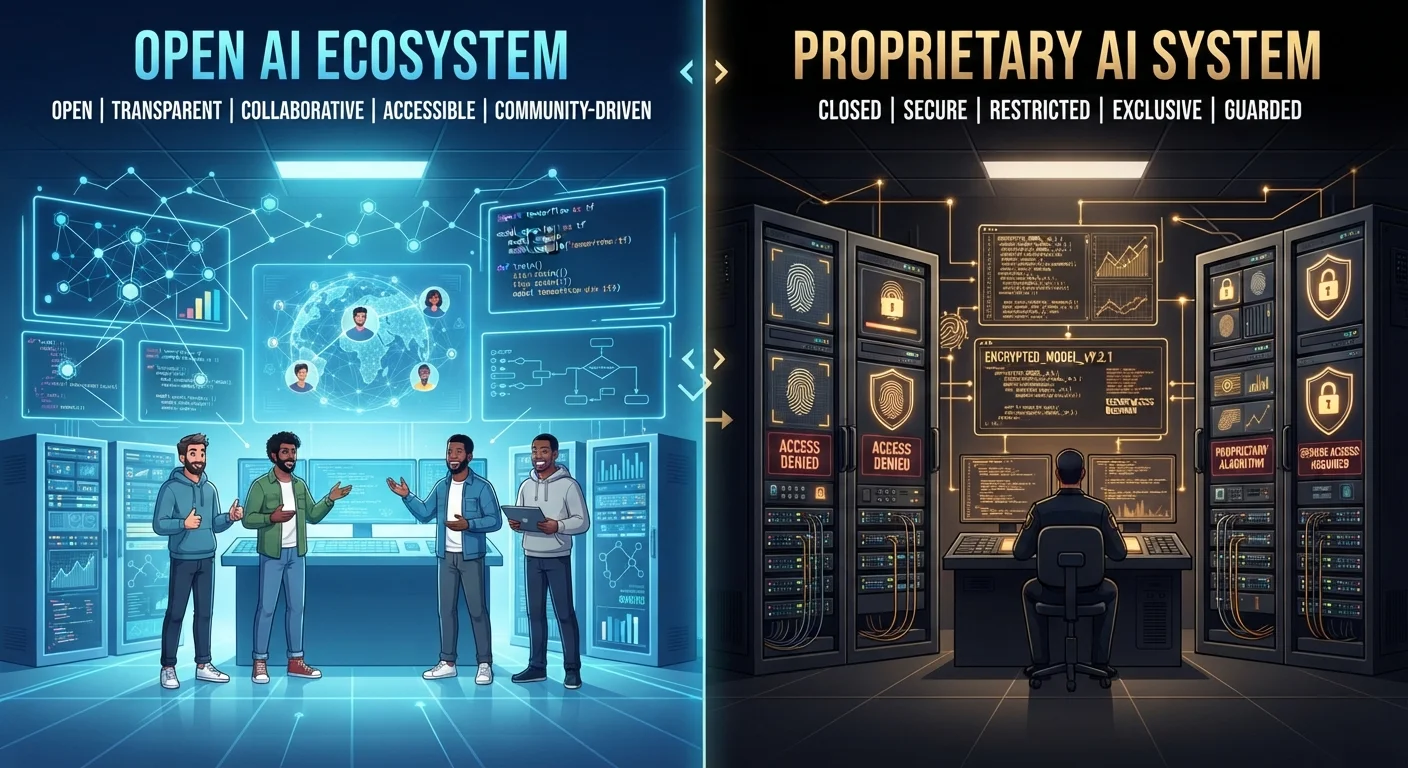
Option A
Open-Source AI Models
The transparent, community-driven approach to artificial intelligence.
Best for: Researchers, developers, and institutions that need to inspect, customize, or audit the underlying model.
Option B
Closed Proprietary Systems
The managed, commercially polished alternative with centralized control.
Best for: Everyday users and businesses seeking a ready-to-use AI service with vendor-backed support and reliability.
What the Terms Actually Mean
The phrase "open-source AI" refers to models whose code, architecture, and — crucially — trained weights are made publicly available. Anyone can download, examine, and in many cases modify these models. Well-known examples include Meta's Llama family and Mistral's released models. "Proprietary" AI systems, by contrast, are developed and controlled by a single company. Users interact with them through an interface or API, but the underlying model remains private. OpenAI's GPT-4 and Google's Gemini are examples of this approach.
Understanding the distinction matters because it shapes everything from how errors get caught to how your data is handled. For a broader grounding in the language surrounding this field, see our plain-language AI terminology guide.
Transparency and Accountability
One of the most significant differences between the two approaches is inspectability. When a model's weights are public, independent researchers can probe it for biases, safety gaps, or unexpected behavior. This kind of external scrutiny has already surfaced real issues in released models — findings that have informed broader conversations about responsible AI development.
Closed systems cannot be audited in the same way. Users must trust that the provider has tested thoroughly and acts in good faith. Some companies publish safety reports or system cards describing their models, but these are self-reported documents, not independent verification.
| Criterion | Open-Source AI | Closed Proprietary AI |
|---|---|---|
| Model visibility | Code and weights publicly available | Private; accessible via API only |
| Independent auditing | Possible by external researchers | Limited to provider self-reporting |
| Customization | High; can be fine-tuned or modified | Low; constrained by vendor options |
| Data privacy options | Can run locally; no data transfer required | Data typically sent to provider servers |
| Ease of use | Requires technical knowledge to deploy | Accessible via polished consumer interface |
| Vendor support | Community-based; no guaranteed SLA | Commercial support often available |
| Misuse risk | Safety filters can be removed by anyone | Provider enforces usage policies centrally |
This accountability gap is directly relevant to questions of AI governance. As regulators develop oversight frameworks, the openness or closure of a model affects how feasible third-party compliance checks actually are.
Privacy, Risk, and Real-World Trade-Offs
For everyday consumers, the privacy implications may be the most immediately relevant difference. When you use a proprietary AI service, your prompts and outputs typically travel to the provider's servers. How that data is stored, used for training, or shared with partners varies by company and changes over time. Understanding those data flows is worth doing before relying on any AI-powered tool for sensitive tasks.
Open-source models can be run locally, keeping data on your own device or internal network. That option exists in theory, but in practice it requires meaningful technical capability and hardware resources. For most consumers, local deployment is not straightforward.
65%+
Share of AI models on Hugging Face that are openly released
Hugging Face, a major AI model repository, hosts hundreds of thousands of models, the majority of which are publicly accessible in some form.
~4x
Compute gap between leading open and closed frontier models
Industry analysts and published model cards suggest leading proprietary frontier models are trained on significantly greater compute than most open-source equivalents.
Open-source release also carries its own risks. A model available to everyone is available to bad actors too. Removing safety filters from open models has been demonstrated to be feasible in research settings, a concern that responsible-AI researchers continue to weigh against the benefits of openness. Neither model type eliminates risk — they simply distribute it differently.
Trust calibration matters regardless of which system you use. Treating AI outputs as automatically accurate is one of the most common mistakes users make, and the source of the model — open or closed — does not change that dynamic.
What This Means for Non-Technical Users
Most consumers will never directly choose between an open-source and a proprietary model. They'll encounter AI embedded in apps, search engines, writing assistants, or classroom tools. But knowing which category a system falls into helps calibrate reasonable expectations about transparency and recourse.
In education contexts, for example, the provenance of an AI tool is increasingly a policy question — not just a technical one. Research on AI in classrooms shows that whether a school understands the underlying system affects how responsibly it can be deployed.
The open vs. closed divide is ultimately a governance question as much as a technical one: who gets to see inside the system, who is accountable when it fails, and who sets the rules. Consumers benefit from understanding those distinctions — even when they never touch a line of code.
This article is for informational purposes only and does not constitute technical, legal, or professional advice.
The content on this site is for informational purposes only and is not a substitute for professional advice. Always consult a qualified professional for guidance specific to your situation.