

How Synthetic Media Is Made
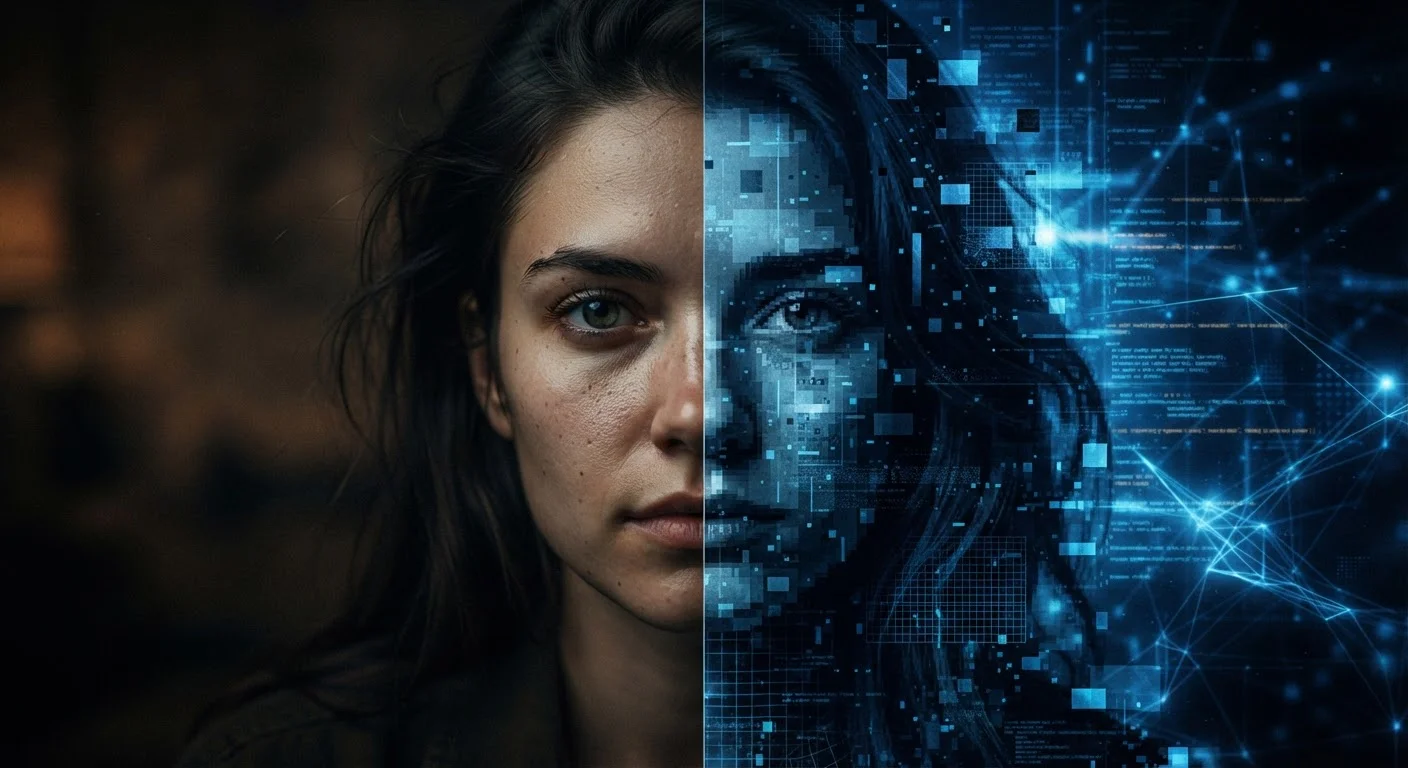
At its core, synthetic media generation is a pattern-recognition problem solved at extraordinary scale. AI systems — typically large generative models — are trained on millions of real images, video clips, or audio recordings. They learn the statistical patterns that define how a human face moves, how a particular voice sounds, or how light behaves in a photograph. Once trained, they can generate new content that fits those learned patterns convincingly.
The two dominant technical approaches are generative adversarial networks (GANs) and diffusion models. GANs pit a generator against a discriminator: the generator tries to produce realistic output, and the discriminator tries to flag it as fake. Over thousands of training cycles, both improve — until the generator produces content the discriminator can no longer reliably reject. Diffusion models work differently, starting from random noise and gradually refining it toward a target output, and have become increasingly dominant for high-quality image and video generation.
Face-swap deepfakes specifically map one person's facial geometry onto another's video footage. Voice cloning tools can replicate a speaker's unique vocal patterns from a relatively short audio sample — sometimes just a few seconds. These capabilities, once requiring significant technical expertise, are now accessible through consumer-facing applications.
Not All Synthetic Media Is a Deepfake
The term 'deepfake' specifically refers to AI-generated or AI-manipulated media depicting real, identifiable people without their consent or in misleading contexts. Synthetic media is the broader category and includes AI art, AI-generated voiceovers with disclosure, and digital effects in film. The distinction matters: the harm in deepfakes typically comes from the deceptive use of a real person's likeness, not from AI-generated content per se.
Why Detection Is So Difficult
Deepfake detection and deepfake generation are engaged in an ongoing technical arms race. Automated detectors are trained on known synthetic media, which means they tend to perform well against yesterday's tools and poorly against today's. When researchers publish a new detection method, it signals to developers which artifacts their generators need to eliminate.
Human visual inspection is equally unreliable. Studies have shown that people, on average, perform only marginally better than chance when trying to identify AI-generated faces in controlled tests. Artifacts that once gave deepfakes away — unnatural eye movement, facial blurring, inconsistent shadows — have largely been eliminated by newer models.
~50%
Human accuracy identifying AI-generated faces
Research published in peer-reviewed psychology and computer science journals has found that people correctly identify synthetic faces at rates only marginally above chance in controlled conditions.
5x
Growth in online deepfake video volume (2019–2023)
Tracking firm Sensity AI reported a roughly fivefold increase in detected deepfake videos circulating online between 2019 and 2023, with the pace accelerating as generation tools became more accessible.
>25 U.S. states
States with deepfake-related legislation
As of recent legislative sessions, more than two dozen U.S. states have enacted or introduced laws specifically targeting non-consensual intimate deepfakes or election-related synthetic media.
Audio deepfakes present their own challenge. Voice cloning has advanced to the point where short-duration samples can produce convincing replicas, making phone-based verification — such as recognizing a loved one's voice — increasingly unreliable. This has practical implications for fraud: scammers have used cloned voices in schemes targeting families and businesses.
The asymmetry between generation and detection is a structural problem. Generation needs only one convincing output; detection must catch every fake — a fundamentally harder task. This is why many researchers argue that detection alone is not a sustainable long-term solution.
Provenance, Watermarking, and Emerging Safeguards
Rather than detecting fakes after the fact, a parallel approach focuses on authenticating real content at the point of creation. The Coalition for Content Provenance and Authenticity (C2PA) — a cross-industry standards body — has developed a technical specification for embedding cryptographically signed metadata into media files. This metadata records who created the file, when, with what device or software, and whether it has been edited. Cameras, phones, and software that implement C2PA essentially attach a verifiable chain of custody to each file.
Some AI developers have also implemented invisible watermarking — patterns embedded in generated content that are imperceptible to viewers but detectable by software. The limitation is that watermarks can be removed or degraded through image compression, cropping, or format conversion.
Verify Before You Share
When you encounter surprising or emotionally charged media, take a moment before sharing. Use reverse image search tools to find the original source context, and check whether reputable news organizations have reported on the same event. If a piece of media is only circulating on one platform or from one account, treat that as a reason to investigate further rather than amplify.
Regulatory frameworks are beginning to catch up. Several U.S. states have enacted laws targeting non-consensual intimate deepfakes, and federal legislative proposals have been introduced, though comprehensive national law remains pending. The European Union's AI Act includes provisions specifically addressing synthetic media and disclosure obligations.
For everyday consumers, the most durable safeguards remain behavioral: checking the source of surprising or inflammatory media, using reverse image search to find original context, and being alert to the assumptions people commonly make when trusting AI outputs. Understanding how synthetic media works is also foundational — see how that intersects with AI-powered apps and data privacy for a broader picture of AI's reach into daily life.
What This Means for Everyday Consumers
Most people will not become forensic deepfake analysts — nor should they need to. But understanding that compelling-looking media can now be fabricated at low cost and effort changes how digital content deserves to be approached. A video of a public figure saying something shocking, an urgent audio message from a family member, or a photograph supporting a polarizing story are all now categories worth pausing over before accepting and sharing.
Synthetic media also raises questions about consent and identity. When someone's likeness or voice can be reproduced without their knowledge, the implications extend beyond misinformation into personal harm — from reputational damage to targeted harassment. These risks are not evenly distributed: research suggests that certain groups, including women and public-facing professionals, are disproportionately targeted by non-consensual synthetic media.
The technology itself is not going away. Synthetic media tools are embedded in creative industries, accessibility applications, and entertainment. The line between human-created and AI-generated content will continue to blur. Staying informed — including learning how to read AI news coverage without being misled — is among the more practical responses available to consumers today.
Frequently Asked Questions
A deepfake is an AI-generated or AI-manipulated piece of media — image, video, or audio — that depicts a real person doing or saying something they never did. The term comes from the 'deep learning' AI method used to create them. They can range from crudely obvious to virtually indistinguishable from authentic recordings.
No single method reliably catches all deepfakes. Common visual signs include unnatural blinking, inconsistent lighting around the face, and blurry edges near hair or teeth. However, the most advanced synthetic media defeats visual inspection entirely. Cross-referencing sources and checking for content credentials or provenance metadata are more dependable strategies.
Legality depends on how deepfakes are used and where you are located. Non-consensual intimate deepfakes are criminalized in a growing number of U.S. states. Using synthetic media to commit fraud or defame someone can trigger existing laws. However, there is currently no single comprehensive federal law in the U.S. specifically addressing all forms of deepfakes.
Automated detection tools exist and can be effective against known generation methods, but they routinely struggle with content produced by newer AI systems. Research consistently shows that detection accuracy declines as generation technology advances. No publicly available tool offers reliable detection across all synthetic media types.
Synthetic media has genuine applications in film and TV production, accessibility tools such as AI-generated voiceovers for people who have lost their speech, educational simulations, and creative art. The underlying technology is not inherently harmful — its impact depends on how and for what purpose it is deployed.
Content provenance refers to a verified record of where a piece of media originated and how it was created or edited. Standards like the Coalition for Content Provenance and Authenticity (C2PA) embed cryptographically signed metadata into files so platforms and viewers can verify authenticity. It doesn't prevent synthetic media from being made, but it gives recipients a way to check a file's origin.
The content on this site is for informational purposes only and is not a substitute for professional advice. Always consult a qualified professional for guidance specific to your situation.