

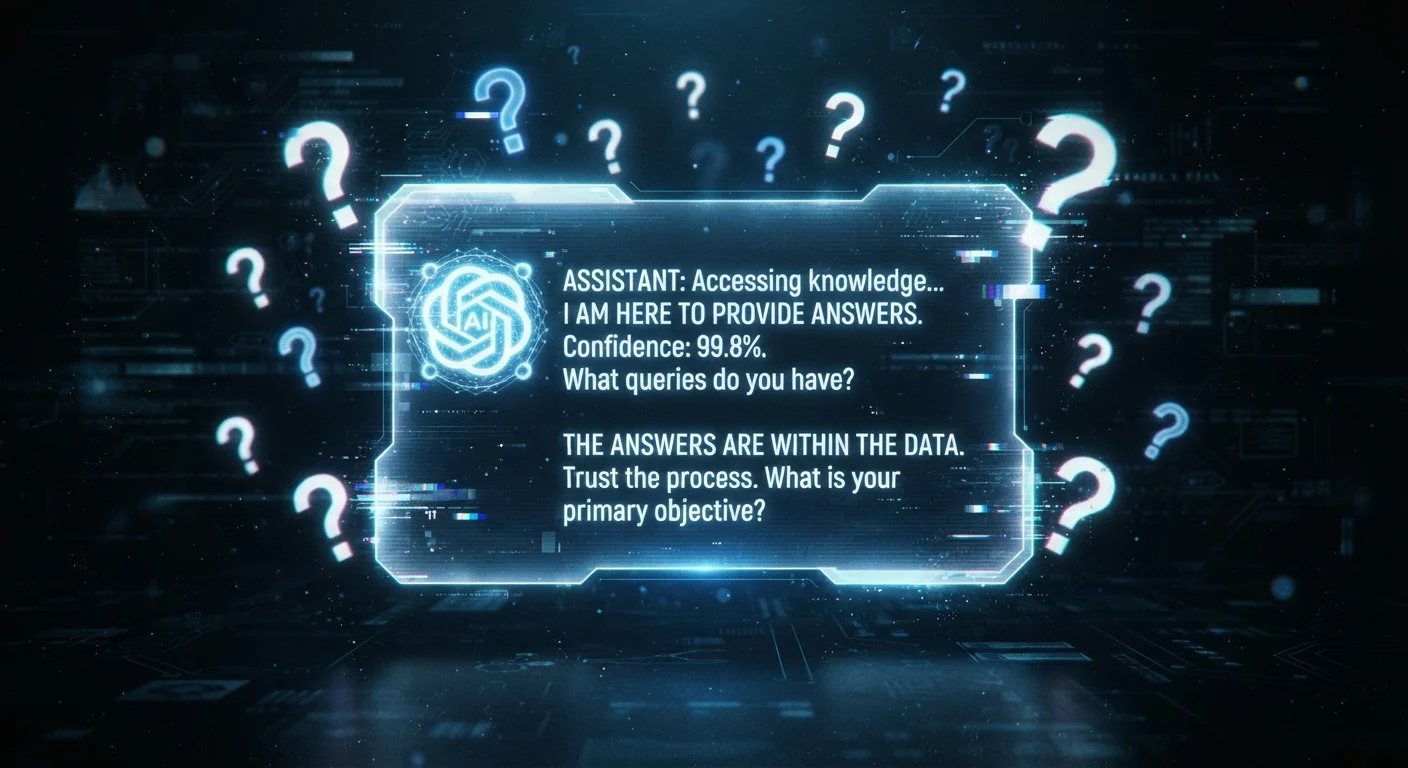
What 'Hallucination' Actually Means in AI
The term hallucination was borrowed from psychology and applied to artificial intelligence to describe a specific failure mode: when a language model generates content that is factually wrong but presented without any hint of doubt. Unlike a search engine that retrieves existing documents, a large language model (LLM) builds its responses word by word, predicting what text should come next based on statistical patterns learned during training.
This means the model is fundamentally optimizing for plausibility, not accuracy. It has no internal fact-checker and no live access to a verified knowledge base (unless specifically designed with one). For a deeper look at the vocabulary surrounding these systems, see our plain-language AI terminology guide.
Hallucination vs. Bias: A Key Distinction
Hallucination refers specifically to factual fabrication — the model inventing information that does not exist. This is distinct from AI bias, which involves skewed or unfair outputs rooted in patterns from training data. Both are serious concerns, but they have different causes and require different mitigation strategies. Understanding the difference helps users ask the right questions about AI reliability.
Why the Problem Is Structural, Not Just a Bug
Many users assume AI hallucinations are rare glitches that engineers will eventually patch. In reality, the tendency to produce fluent-sounding falsehoods is baked into how these models work. LLMs are trained on enormous datasets of human-written text. They learn the shape of language — how facts are phrased, how citations look, how confident prose sounds — without independently verifying whether any given claim is true.
When asked about an obscure legal case, a specific medical study, or an obscure historical figure, the model may generate a convincing-sounding answer because that kind of answer fits the pattern of responses it has seen. The result can be an invented court case with a real-sounding name, a fabricated journal article with plausible authors, or a misattributed quote. These errors are not random noise — they are coherent, well-formed, and easy to miss.
~3%–27%
Hallucination rate range across LLM benchmarks
Research published in peer-reviewed venues has found hallucination rates vary widely depending on task type, model, and evaluation method — underscoring that no current system is immune.
Majority
AI users who don't verify chatbot claims
Multiple surveys of AI users have found that a majority do not routinely fact-check chatbot responses before acting on or sharing them, according to published consumer research.
Everyday Situations Where Hallucinations Cause Real Harm
For casual tasks — brainstorming ideas, drafting a birthday message, summarizing a concept you already understand — hallucinations may have little practical consequence. But the stakes rise sharply in higher-stakes situations.
Professionals have submitted legal briefs citing cases that do not exist after relying on AI-generated research. Students have included fabricated sources in academic work. People have received plausible-sounding but incorrect health information. The common thread is that confident, well-structured output lowered the reader's guard. Understanding the assumptions people make when trusting AI outputs can help readers recognize when that guard should stay up. The education sector faces its own version of this challenge — separating genuine AI potential from overstated promise in classrooms requires similar critical awareness.
How to Protect Yourself From AI Misinformation
The practical safeguard is straightforward but requires discipline: never treat AI output as a primary source. Use it as a starting point, then verify any specific claim — a statistic, a date, a name, a citation — against a reliable, independent source before acting on it or sharing it.
Pay particular attention to highly specific details. Hallucinations frequently involve exactly the kind of precise-sounding information that feels most authoritative: exact percentages, full names, publication titles, legal case numbers. That precision is itself a red flag worth checking. For guidance on evaluating AI-related claims more broadly, our guide to reading AI news without being misled offers practical steps.
“These models do not have a concept of truth. They have a concept of what text looks like. That's a very different thing, and conflating the two is where a lot of the real-world harm comes from.”
— Yann LeCun, Chief AI Scientist, Meta; Turing Award laureate
Frequently Asked Questions
AI language models are trained to produce text that sounds coherent and plausible based on patterns in vast amounts of data. They are not designed to fact-check their own outputs or signal uncertainty reliably, so incorrect information is often delivered with the same confident tone as accurate information.
Not with current technology. Researchers are actively working to reduce hallucination rates through better training methods and fact-grounding techniques, but no AI system today can guarantee it will never produce false information. Users should treat all AI-generated content as a starting point, not a final source.
Look for specific details that can be verified — dates, names, citations, statistics — and check them against authoritative primary sources. If an AI cites a study or a quote, search for the original source independently. Be especially skeptical of highly specific claims you haven't encountered before.
Performance varies across models and tasks, and benchmarks are evolving rapidly. However, all current large language models can and do hallucinate. Tasks requiring precise factual recall, such as legal case citations or medical dosages, tend to carry higher risk regardless of which tool is used.
AI tools can help brainstorm, summarize, or draft ideas, but they should not be treated as authoritative research sources. For consequential decisions in areas like health, finance, or legal matters, always verify information with qualified professionals and primary sources.
The content on this site is for informational purposes only and is not a substitute for professional advice. Always consult a qualified professional for guidance specific to your situation.