

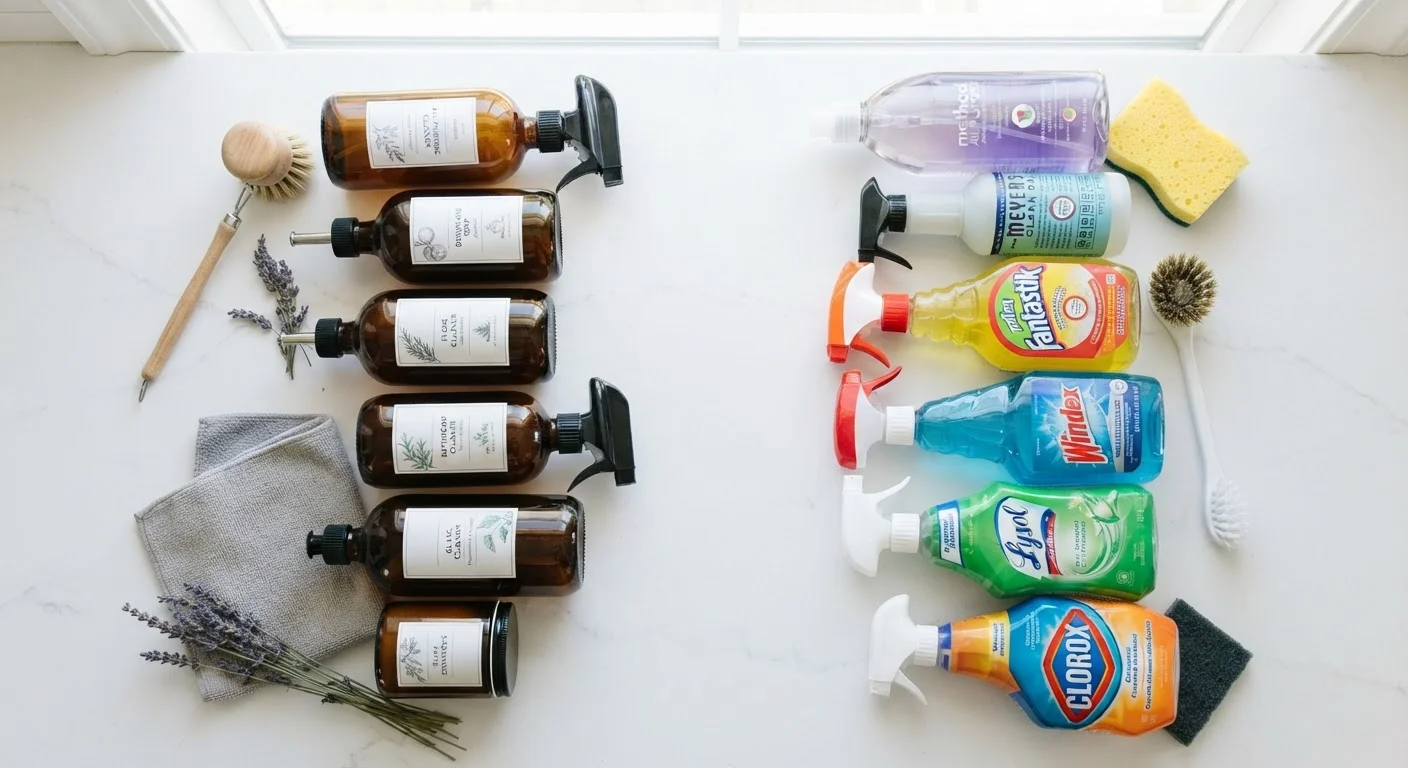
Our Verdict
Neither category is universally superior. Conventional cleaners hold a clear edge for hospital-grade disinfection and proven pathogen elimination, while plant-based options perform comparably for routine household cleaning with a generally lower chemical load. The smartest approach for most households is a context-driven mix of both.
| Best for | Recommended |
|---|---|
| Everyday surface cleaning and general tidying | Natural or plant-based cleaners |
| Kitchens, bathrooms, or situations requiring verified pathogen elimination | Conventional EPA-registered disinfectants |
| Households with sensitivities to synthetic fragrances or dyes | Fragrance-free natural or certified-safer conventional cleaners |
| Environmentally focused consumers prioritizing packaging and biodegradability | Certified plant-based cleaners with transparent ingredient disclosure |
The Rise of 'Natural' Cleaning — and What That Label Actually Means
Americans spent an estimated $700 million on natural household cleaning products in a recent multi-year tracking period, and that figure continues to climb. Walk any grocery aisle and you'll spot claims like "plant-based," "non-toxic," and "eco-friendly" splashed across pastel bottles. The appeal is intuitive: if it sounds closer to nature, it must be gentler on people and the planet.
The problem is that no federal regulatory body in the U.S. defines "natural" for cleaning products. Unlike food labeling, where the FDA and USDA apply at least some standards, cleaning product marketers can use "natural" almost at will. That makes label-reading — checking the actual ingredient list — far more revealing than any front-of-bottle claim. The same scrutiny applies in sustainable fashion, where marketing language frequently outruns the reality.
Efficacy: Where Each Type Excels (and Struggles)
On routine cleaning tasks — cutting grease on countertops, removing soap scum, general surface wiping — independent testing has repeatedly shown that well-formulated plant-based cleaners perform comparably to many conventional products. Ingredients like citric acid, castile soap (a vegetable oil–derived soap), and plant-derived surfactants are genuinely effective at breaking down dirt and organic residue.
Disinfection is a different story. The U.S. Environmental Protection Agency (EPA) maintains a list of registered disinfectants — products that have demonstrated the ability to kill specific pathogens under controlled conditions. Most conventional disinfectant sprays and wipes appear on that list. Most plant-based products do not, because registration requires rigorous third-party efficacy testing that many smaller brands have not pursued.
That distinction matters most during illness season, in households with immunocompromised members, or any time genuine germ elimination (not just surface cleaning) is the goal.
| Criteria | Natural / Plant-Based Cleaners | Conventional Cleaners | |
|---|---|---|---|
| Everyday cleaning efficacy | Comparable for routine tasks | Strong across most surfaces | |
| Disinfection (EPA-registered) | Rarely registered; limited data | Many EPA-registered options | |
| Fragrance & allergen risk | Essential oils can irritate | Synthetic fragrances can irritate | |
| Label transparency | Varies widely; often better | Varies; required Safety Data Sheets | |
| Biodegradability | Generally higher | Improving but variable | |
| Cost | Often higher per unit | Generally lower per unit |
Safety Considerations: Reading Past the 'Non-Toxic' Promise
Conventional cleaners rightfully draw scrutiny for ingredients like quaternary ammonium compounds ("quats"), chlorine bleach, and synthetic musks. Some of these have documented links to respiratory irritation with repeated high-level exposure, and certain quats have been flagged in research for potential antimicrobial resistance concerns.
But plant-based formulas carry their own cautions. Essential oils — eucalyptus, tea tree, citrus — are among the most common natural fragrance ingredients, and they are also common allergens and respiratory irritants. Boric acid, sometimes used as a natural preservative, can be harmful if ingested. The takeaway: ingredient origin does not equal safety profile. Toxicity depends on dose, exposure route, and individual sensitivity — not the ingredient's Latin name.
Look for the EPA Safer Choice Label
The EPA's Safer Choice certification indicates that a product's ingredients have been evaluated for human and environmental safety. It bridges both worlds — some certified products are plant-derived, others are conventional formulas. Looking for this label is one of the most reliable shortcuts available when you want third-party-backed safety assurance rather than marketing claims.
For households with asthma, young children, or fragrance sensitivities, the framework for evaluating wellness trends is genuinely useful here: look for transparent ingredient disclosure, third-party certification (like EPA Safer Choice), and peer-reviewed evidence rather than marketing language alone.
Environmental Impact: A More Complicated Picture
Plant-based cleaners are frequently marketed as better for the environment, and in some respects they are. Biodegradable surfactants break down more readily in waterways. Concentrated refillable formats meaningfully reduce plastic waste. However, "plant-based" does not automatically mean low environmental impact: some botanical ingredients require significant agricultural land and water to produce, and fragrance components — natural or synthetic — can contribute to indoor and outdoor air quality issues.
Conventional cleaner manufacturers have also made meaningful formulation strides, with many brands reformulating to remove phosphates and reduce aquatic toxicity. Life-cycle analysis — measuring environmental impact from raw material extraction through disposal — consistently shows that packaging and transportation choices matter as much as the ingredient list itself.
This article is for general informational purposes only and does not constitute medical, health, or safety advice. Always consult product labels and, where relevant, a qualified professional before making changes to your household cleaning routine.
The content on this site is for informational purposes only and is not a substitute for professional advice. Always consult a qualified professional for guidance specific to your situation.