

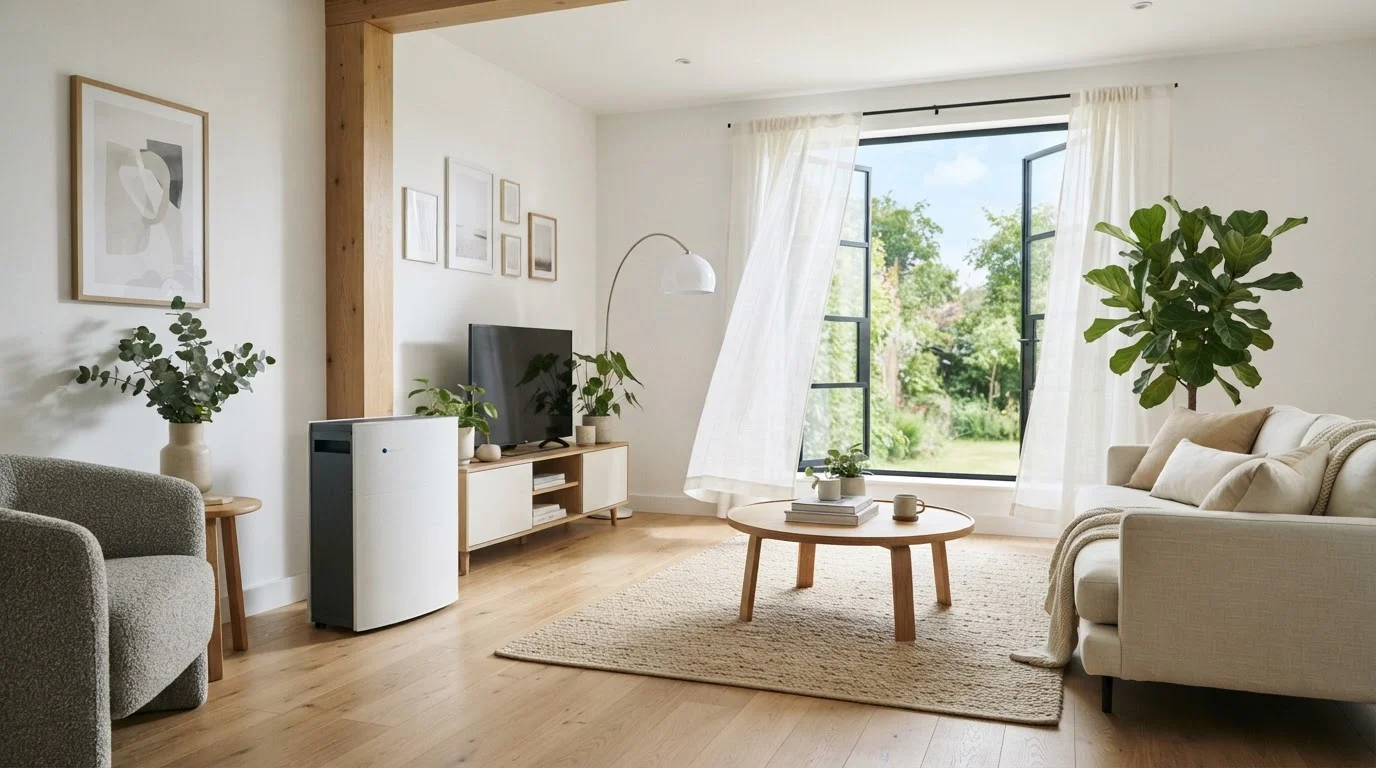
Option A
Air Purifiers
The targeted, technology-driven filtration solution.
Best for: Homes where outdoor air quality is poor, allergies are a concern, or opening windows isn't practical.
Option B
Ventilation
The foundational, whole-home air exchange strategy.
Best for: Households looking to dilute indoor pollutants at the source and maintain consistent fresh airflow.
The Core Difference: Filtering vs. Replacing
Indoor air quality has become a genuine daily-life concern for millions of Americans — and for good reason. The Environmental Protection Agency has noted that indoor air can be significantly more polluted than outdoor air in many circumstances. Two broad strategies dominate the conversation: air purifiers and ventilation. But they solve fundamentally different problems.
An air purifier pulls existing room air through a filter — typically a HEPA (High-Efficiency Particulate Air) filter — trapping particles like dust, pollen, mold spores, and pet dander. Some models add activated carbon layers to absorb gases and odors. The air circulates within the same enclosed space; nothing new enters from outside.
Ventilation, by contrast, exchanges indoor air with outdoor air. It can be as simple as opening a window or as sophisticated as a heat recovery ventilator (HRV) built into your HVAC system. The goal is dilution — flushing out carbon dioxide, cooking byproducts, humidity, and volatile organic compounds (VOCs) that build up when a space is sealed.
Understanding that distinction is the starting point for every decision that follows.
| Criterion | Air Purifiers | Ventilation |
|---|---|---|
| Primary function | Filter particles from existing air | Replace stale air with fresh outdoor air |
| Removes CO₂ buildup | No | Yes |
| Handles fine particles & allergens | Yes (HEPA-rated) | Partially, via dilution |
| Effective during poor outdoor AQI | Yes | No — can worsen indoor air |
| Reduces VOCs & odors | Only with activated carbon filter | Yes, through dilution |
| Structural changes required | No — portable | Depends on system type |
| Ongoing maintenance cost | Filter replacements every 6–12 months | Low (fans, filters in HRV systems) |
| Covers whole home | No — room by room | Yes, with proper system design |
What Each Approach Does Well — and Where It Falls Short
Air purifiers excel at capturing particulate matter — the tiny solid and liquid particles that irritate airways and trigger allergic responses. A true HEPA filter is rated to capture 99.97% of particles at 0.3 microns, which covers most common household allergens. They're also portable, require no structural changes, and can be sized to specific rooms.
Their limitations are real, though. Standard purifiers do nothing to remove carbon dioxide, radon, or most gaseous pollutants unless a carbon filter is included. They recirculate the same air, meaning high occupancy rooms still accumulate CO₂ over time, which can cause fatigue and reduced concentration. And they only clean air that passes through them — a purifier in the bedroom won't help the living room.
Ventilation addresses the whole-home picture. It lowers CO₂, reduces humidity that feeds mold, and dilutes VOCs from furniture, cleaning products, and building materials. Mechanical systems like HRVs can do this year-round without sacrificing energy efficiency by recovering heat from outgoing air.
The catch: ventilation is only as clean as the outdoor air it draws in. On high-pollution days — wildfire smoke events, heavy pollen seasons, or smoggy urban afternoons — bringing in outside air can make things worse. Ventilation also does little to reduce concentrated allergen sources already present indoors.
2–5x
How much more polluted indoor air can be vs. outdoors
The U.S. Environmental Protection Agency has cited indoor air as potentially 2 to 5 times more polluted than outdoor air in some contexts.
90%
Share of time Americans spend indoors on average
EPA estimates suggest Americans spend approximately 90 percent of their time indoors, making indoor air quality a significant daily health consideration.
99.97%
Particle capture rate of true HEPA filters
HEPA filtration standards require capture of at least 99.97% of airborne particles at 0.3 microns — the most penetrating particle size.
Making the Right Choice for Your Home
For most households, the honest answer is that both strategies have a role — but the priority depends on your specific context.
If your home was built before the 1980s with natural drafts and gaps, you likely get more passive ventilation than you realize. A targeted air purifier in high-use spaces may be the more impactful upgrade. If your home is newer and tightly sealed — a hallmark of energy-efficient construction — inadequate ventilation is the bigger risk, and mechanical systems should be the foundation.
Geography matters enormously. Households in cities with chronic air quality challenges, near agricultural areas with heavy pesticide use, or in wildfire-prone regions often need the combination: smart ventilation that can be closed during pollution events paired with a purifier that handles the fallout.
Budget is another real factor. A quality air purifier requires ongoing filter replacement costs — HEPA filters typically need replacement every six to twelve months depending on usage. Mechanical ventilation systems carry upfront installation costs but lower long-term consumable expenses. Neither is a one-time purchase.
The most practical approach for most American households: audit your existing ventilation first (check exhaust fans in bathrooms and kitchens, look at how airtight your windows are), address any clear gaps there, and then evaluate whether a room-specific purifier adds meaningful value on top of that foundation.
This article is for general informational purposes only and does not constitute medical or health advice. Consult a qualified healthcare professional if you have specific respiratory health concerns.
The content on this site is for informational purposes only and is not a substitute for professional advice. Always consult a qualified professional for guidance specific to your situation.