

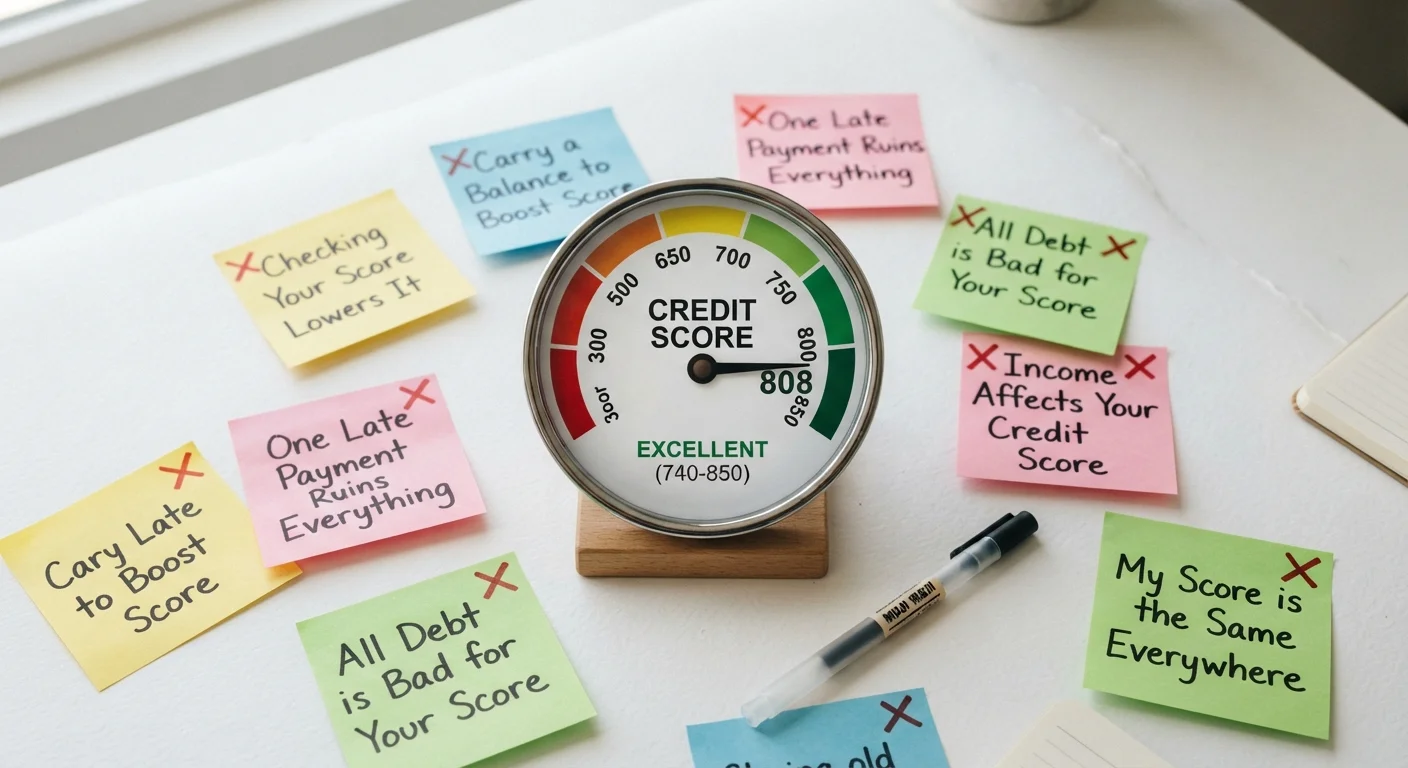
Why Credit Score Myths Persist — and Why They Matter
Credit scores influence some of the largest financial decisions Americans make: mortgage approvals, auto loan rates, apartment applications, and even certain employer background checks. Despite their importance, a surprising number of widely repeated beliefs about how scores work are simply wrong.
These aren't harmless misunderstandings. Acting on bad information — closing an old account, avoiding credit checks, or carrying a balance to "show activity" — can produce real, measurable drops in your score at exactly the wrong moment. For consumers navigating the US banking and credit landscape, separating myth from fact is foundational to sound financial decision-making.
The myth-and-fact pairs below reflect the misconceptions most likely to lead to financial harm. Each one is grounded in how the major credit scoring models — including FICO and VantageScore — actually work.
Myth
Checking your own credit score will lower it.
Fact
Checking your own credit report or score is a "soft inquiry" and has no effect on your score whatsoever.
Credit inquiries come in two types. A hard inquiry occurs when a lender pulls your credit as part of an application decision — this can cause a small, temporary score dip. A soft inquiry occurs when you check your own credit, or when a lender pre-screens you for an offer. Soft inquiries do not affect your score under any major scoring model.
Avoiding your own credit report out of this fear is counterproductive. Regular monitoring helps you catch errors and identity theft early. The major bureaus — Equifax, Experian, and TransUnion — are required by federal law to provide consumers one free report annually through AnnualCreditReport.com.
Myth
Closing old credit cards improves your score by removing unused accounts.
Fact
Closing old accounts typically hurts your score by reducing your total available credit and potentially shortening your credit history.
Two key scoring factors are directly affected when you close an old card. First, your credit utilization ratio — the percentage of available credit you're using — rises when available credit shrinks, which signals higher risk to scoring models. Second, length of credit history accounts for a meaningful share of most scores; older accounts contribute positively to this metric even if rarely used.
Unless a card carries a fee that outweighs its benefit, keeping old accounts open and occasionally active is generally the better approach. If you're managing existing card debt, also see common mistakes when paying off credit card debt.
Myth
Carrying a small balance each month helps build your credit score.
Fact
Carrying a balance has no credit-building benefit and costs you interest charges that provide no scoring advantage.
This myth likely originates from confusing "using credit" with "carrying a balance." Scoring models reward responsible credit use — meaning you use the card and pay it off — not the act of leaving a balance to accrue interest. Paying your statement balance in full each month demonstrates disciplined credit behavior and keeps your utilization low.
Carrying a revolving balance costs real money. Compounding interest on unpaid balances adds up quickly, as explained in more detail in why carrying a credit card balance costs more than it looks. There is no financial or credit-scoring reason to pay interest unnecessarily.
Myth
A single missed payment won't make much difference to your score.
Fact
One missed payment — particularly on a previously clean record — can cause a significant score drop and remains on your report for up to seven years.
Payment history is the single largest factor in most credit scoring models, typically accounting for around 35% of a FICO score. A payment that becomes 30 or more days late is reported to the bureaus and can produce a substantial score decrease. The impact is often sharpest for consumers with otherwise strong scores, since they have more to lose.
The negative mark doesn't disappear quickly. Late payments generally remain on credit reports for seven years from the date of the original delinquency, though their impact on scoring typically diminishes over time as the account ages and positive history accumulates.
Myth
Your income directly affects your credit score.
Fact
Income is not a factor in any major credit scoring model. Your score reflects how you manage debt, not how much you earn.
Credit scores are calculated using data from your credit report, which includes payment history, amounts owed, credit history length, credit mix, and new credit. Income, employment status, and net worth do not appear on credit reports and are not used by FICO or VantageScore models.
This distinction matters in both directions: a high earner with poor payment habits can have a low score, while someone with a modest income but a disciplined credit history can maintain an excellent one. Lenders may separately consider income when evaluating ability to repay a loan, but that is distinct from the credit score calculation itself. For a broader look at personal finance fundamentals, sound credit management is one piece of a larger picture.
The Broader Cost of Acting on Bad Information
The consequences of credit score myths compound over time. A consumer who closes several old accounts believing it "cleans up" their profile may inadvertently slash their available credit and shorten their credit history length — two factors that together account for a significant share of most scoring models. The resulting score drop can translate directly into a higher interest rate on a mortgage or auto loan, costing thousands of dollars over the life of the loan.
35%
Share of FICO score from payment history
According to FICO's publicly published score factor breakdown, payment history carries more weight than any other single factor.
7 years
How long a late payment stays on your report
Under the Fair Credit Reporting Act, most negative items — including late payments — can remain on a consumer's credit report for up to seven years.
30%
Score weight from credit utilization
Amounts owed, including your credit utilization ratio, account for roughly 30% of a standard FICO score, making it the second-largest factor.
Similarly, someone who avoids checking their own report out of fear of damage may miss errors — including accounts they didn't open — that are quietly dragging their score down. Under the Fair Credit Reporting Act, consumers have the right to dispute inaccurate information. You can learn more about your rights under the Fair Credit Reporting Act and how to use them.
If your score has already taken a hit from one of these myths, the path forward is methodical: pay on time, keep balances low relative to your credit limits, and avoid unnecessary new applications. For those just getting started, building credit responsibly from zero follows the same core principles. And if a loan application has already been denied, what to do after a denial outlines your next steps under federal law.
This article is for general informational and educational purposes only and does not constitute personalized financial or legal advice. Consult a qualified financial professional regarding decisions specific to your situation.
The content on this site is for informational purposes only and is not a substitute for professional advice. Always consult a qualified professional for guidance specific to your situation.