

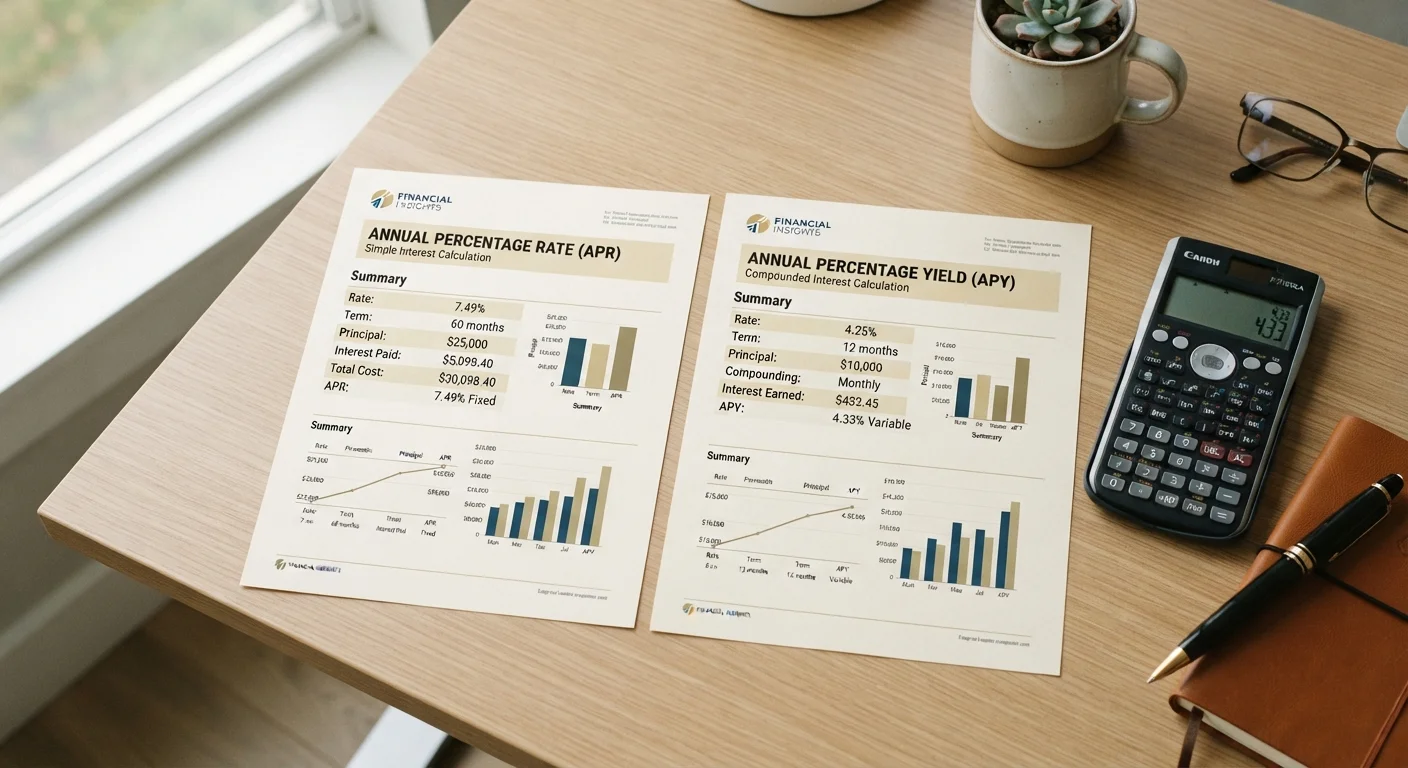
Option A
Annual Percentage Rate (APR)
The cost you pay when borrowing money.
Best for: Understanding the true cost of loans, credit cards, and mortgages before you borrow.
Option B
Annual Percentage Yield (APY)
The return you earn when saving or investing.
Best for: Evaluating how much interest your deposits or savings accounts will actually generate over a year.
Why Two Such Similar Terms Exist
Walk into any bank, open any credit card offer, or browse a savings account page and you will encounter both APR (Annual Percentage Rate) and APY (Annual Percentage Yield). One letter separates them; their meanings, however, point in opposite directions. APR answers the question "What does borrowing cost me?" APY answers "What will I actually earn on my savings?" Conflating the two can lead consumers to dramatically misjudge the cost of a loan or the return on a deposit account.
Federal disclosure rules — chiefly the Truth in Lending Act for credit products and the Truth in Savings Act for deposit accounts — require financial institutions to display these figures clearly. The intent is to give consumers an apples-to-apples basis for comparison. Understanding what each number captures, and what it leaves out, is essential for making sense of those disclosures. For a broader grounding in financial terminology, see Personal Finance Terms Every Adult Should Know.
How APR Is Calculated and What It Includes
APR expresses the yearly cost of borrowing as a percentage of the loan principal. Crucially, the federal definition of APR requires lenders to fold in certain fees — origination charges, mortgage points, and other mandatory costs — alongside the stated interest rate. This is what distinguishes APR from a bare interest rate: it is a broader cost measure designed to prevent lenders from advertising an attractively low rate while burying fees elsewhere.
However, APR does not reflect compounding. It is calculated on a simple-interest basis, which means it understates the true annualized cost for credit card balances that carry over month to month, since interest on those products compounds daily or monthly. For mortgages and installment loans with fixed repayment schedules, APR is a more reliable cost indicator because interest accrues more predictably.
| Criterion | APR | APY |
|---|---|---|
| What it measures | Cost of borrowing | Return on savings |
| Includes compounding? | No — simple interest basis | Yes — compounding included |
| Includes fees? | Yes — mandatory loan fees | No — interest earnings only |
| Governed by | Truth in Lending Act (TILA) | Truth in Savings Act (TISA) |
| Higher number means | Borrowing costs more | Savings earn more |
| Typical products | Mortgages, credit cards, personal loans | Savings accounts, CDs, money markets |
How APY Differs: Compounding Is the Key
APY uses a formula that incorporates compounding — the process by which interest earned in one period is added to the principal, and then itself earns interest in subsequent periods. The more frequently interest compounds (daily, monthly, or quarterly), the higher the APY relative to the nominal interest rate. A savings account advertised at a 4.80% nominal rate compounding daily will carry an APY slightly above 4.91%, because each day's interest is added to the balance before the next day's interest is calculated.
This distinction matters enormously over time. When evaluating deposit products, consumers should compare APYs directly rather than nominal rates, because the APY is the figure that reflects what the account will actually deliver at year's end.
Daily
Most common compounding frequency for US savings accounts
Most major US banks and online savings accounts compound interest daily, which maximizes the gap between a nominal rate and the APY.
~2.7%
Typical APY premium over nominal rate at 24% APR, daily compounding
A 24% APR credit card compounding daily carries an effective annual rate of approximately 26.8%, illustrating how compounding inflates borrowing costs on revolving balances.
It is also worth noting that while APY works in a saver's favor — compounding amplifies returns — the same compounding mechanism works against borrowers on revolving debt. A credit card with an 24% APR compounding daily carries an effective annual rate closer to 26.8%, which is why the APR figure can understate what a cardholder actually pays if they carry a balance.
This article provides general financial education and is not personalized financial or investment advice. Consult a qualified financial professional for guidance specific to your situation.
Practical Side-by-Side: What to Look For
Knowing which figure to focus on depends entirely on which side of a financial transaction you are on. When borrowing, a lower APR reduces your cost, though you should also confirm whether the APR includes all mandatory fees or only some. When saving, a higher APY increases your return, and you should verify how frequently interest compounds — daily compounding typically produces a higher APY than monthly compounding at the same nominal rate.
Promotional Rates and Introductory Periods
Some credit cards and deposit accounts advertise introductory APR or APY figures that apply only for a limited period — often six to eighteen months. After the promotional window closes, the rate reverts to the standard figure disclosed in the fine print. Always check both the promotional and the post-promotional rates before opening an account or accepting a credit offer.
One common source of confusion is promotional language. A bank may advertise a high "interest rate" on a savings account without immediately highlighting the APY, or a lender may lead with an "as low as" interest rate that excludes fees reflected in the APR. Federal rules require the complete figures to appear in disclosures, but they are not always front and center in marketing materials. Reading the full disclosure — not just the headline figure — remains the most reliable approach.
The content on this site is for informational purposes only and is not a substitute for professional advice. Always consult a qualified professional for guidance specific to your situation.