

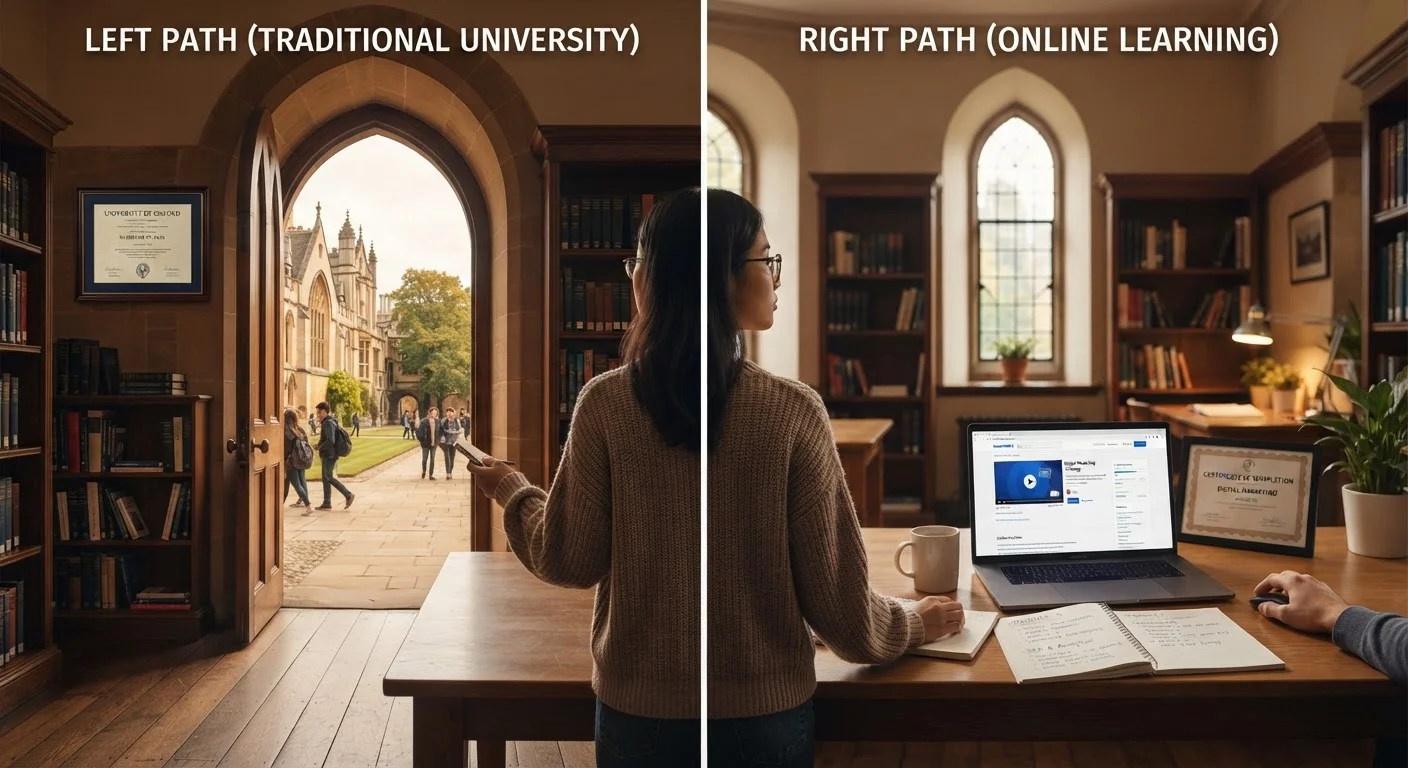
Option A
Formal Degree Programmes
The established, comprehensive academic pathway.
Best for: Adult learners seeking deep theoretical grounding, professional licensure requirements, or employer recognition tied to accredited credentials.
Option B
Online Certificates
The flexible, skill-focused alternative for busy adults.
Best for: Working adults who need to upskill quickly, change careers, or demonstrate specific competencies without a multi-year time commitment.
The Core Difference: Depth vs. Speed
Formal degree programmes — associate, bachelor's, or master's degrees — are multi-year commitments built around a structured curriculum developed by accredited institutions. They combine general education requirements with specialized coursework, and in many cases include internships, research, or capstone projects. The emphasis is on breadth of knowledge alongside depth in a field.
Online certificates, by contrast, are typically narrow, competency-focused credentials that target specific skills. A certificate in project management, UX design, or data analytics might take anywhere from a few weeks to six months to complete. They are designed to be immediately applicable — skills you can demonstrate to an employer without waiting years to graduate.
Understanding how adult education has evolved helps frame this choice. As explored in our overview of where adult education stands today, the growth of online learning has fundamentally shifted what's possible for working adults who cannot relocate or pause their careers.
| Criterion | Formal Degree | Online Certificate |
|---|---|---|
| Typical duration | 2–4+ years | Weeks to 6 months |
| Cost range (U.S.) | Tens of thousands of dollars | Free to a few thousand dollars |
| Accreditation standard | Formally accredited institutions | Varies widely by issuer |
| Employer recognition | Broadly recognized across sectors | Industry- and context-dependent |
| Schedule flexibility | Moderate (more online options now) | High — largely self-paced |
| Required for licensure | Yes, in many regulated fields | Rarely sufficient alone |
| Depth of knowledge | Broad and deep curriculum | Narrow, skill-specific focus |
Accreditation, Recognition, and the Employer Question
One of the most consequential factors in this comparison is how employers and professional bodies treat each credential. Accreditation — the formal process by which educational programmes are evaluated against quality standards — is well-established for degree-granting institutions. Regional accreditation in the U.S. (granted by bodies recognized by the Department of Education) signals that a degree meets rigorous academic standards.
Online certificates occupy a more varied landscape. Some are issued by accredited universities and carry significant weight. Others come from tech companies, professional associations, or independent platforms, and their value depends heavily on industry context. A certificate from a recognized technology firm may carry real weight in a hiring decision in that sector, while the same credential might mean little in healthcare or law.
40%
U.S. adults enrolled in some form of post-secondary education
According to the National Center for Education Statistics, roughly 40% of U.S. undergraduates are adults aged 25 and older, reflecting the scale of adult participation in formal education.
77%
Employers who view online credentials as credible
A Northeastern University survey found that a large majority of employers view online degrees and credentials as equivalent to those from traditional institutions, though perceptions vary by sector.
$1,000–$5,000
Typical cost range for professional online certificates
Many widely recognized professional certificates from universities or major online platforms fall in this range, compared to degree programmes costing far more overall.
Before enrolling in any programme, verifying the issuing body's credentials is essential. Our checklist for evaluating any online course walks through exactly what to look for, including how to assess instructor credibility and programme outcomes.
Cost, Time, and Life Circumstances
For most adult learners, time and money are the decisive variables. A bachelor's degree at a four-year public university carries an average cost of tens of thousands of dollars and requires years of sustained study. For adults with jobs, families, and financial obligations, that investment demands careful planning and often student loan debt.
Online certificates typically cost far less — sometimes hundreds of dollars rather than tens of thousands — and can often be completed around a full-time schedule. That accessibility is significant. However, the lower cost does not automatically mean lower value; it means the value must be evaluated differently, based on industry fit, issuer reputation, and the skills taught.
It's also worth noting that these paths are not always mutually exclusive. Many adult learners begin with a certificate to validate interest in a new field, then pursue a degree once direction is clear. The case for and against returning to formal education as an adult offers a balanced look at what re-entry into degree programmes actually looks like for people later in life.
For a broader map of learning formats beyond these two, our breakdown of MOOCs, bootcamps, and community classes provides useful context on the full range of options available today.
Micro-Credentials: A Related Option Worth Knowing
Between full certificates and formal degrees sits a growing category called micro-credentials — short, stackable units of learning that can accumulate into larger qualifications. They aren't quite the same as traditional certificates, and the terminology can be confusing. Our explainer on micro-credentials clarifies what they are, who offers them, and when they make strategic sense for adult learners.
The content on this site is for informational purposes only and is not a substitute for professional advice. Always consult a qualified professional for guidance specific to your situation.