

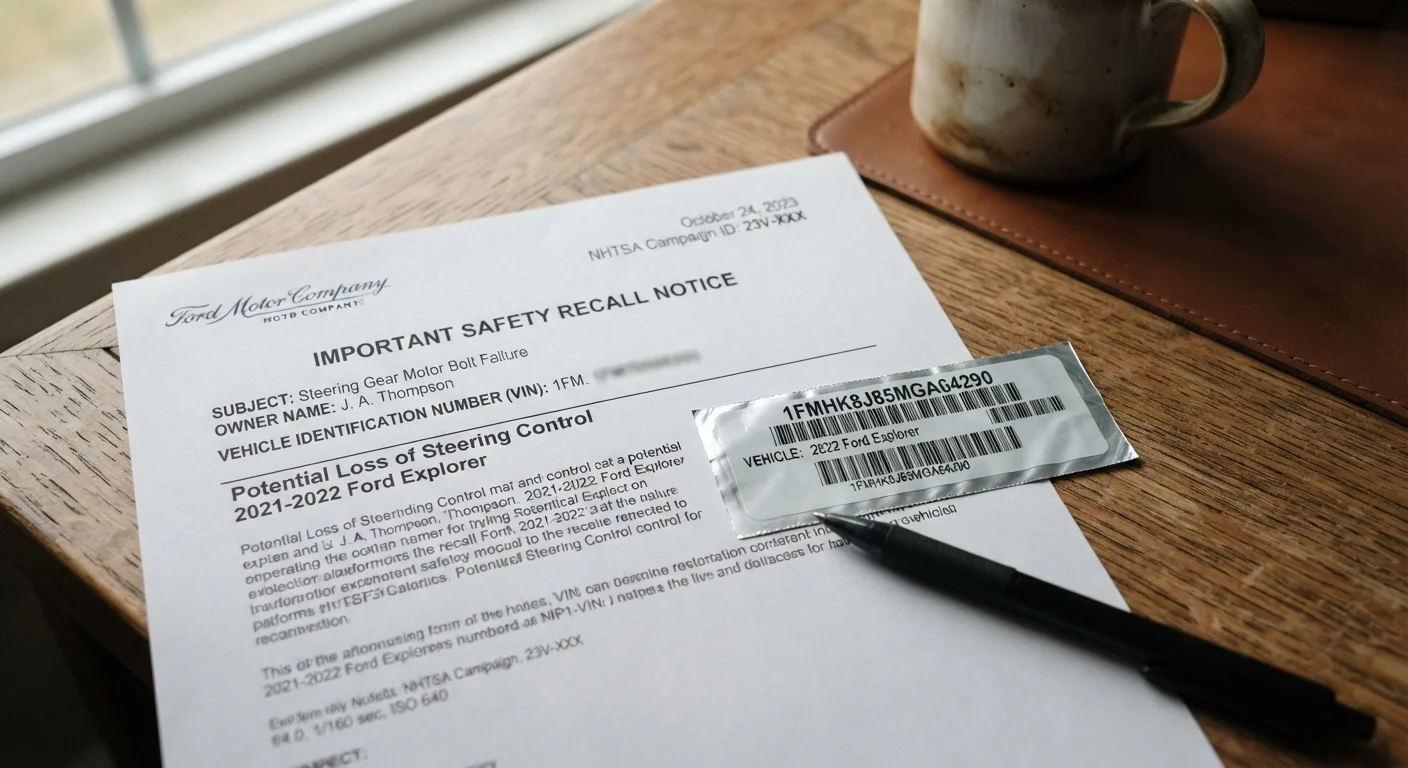
Why Recall Notices Require Your Full Attention
Automotive recall notices are not marketing mail. They represent a manufacturer's legal obligation — enforced by the National Highway Traffic Safety Administration (NHTSA) — to notify owners of a confirmed safety defect or a vehicle's failure to meet federal motor vehicle safety standards. Understanding what triggers a recall and what happens next is useful background, but the practical skill most owners lack is reading the notice itself without glossing over the details that matter most.
Recall notices follow a federally required format, which means every letter contains the same categories of information — if you know where to look. The challenge is that dense regulatory language can cause readers to skim past the fields that actually determine whether and how urgently they need to act. This guide walks through each of those fields systematically.
What you will need
It is also worth noting that recall scopes are routinely misunderstood when filtered through news coverage. A headline may say a manufacturer is recalling a million vehicles when your specific configuration is unaffected. The only authoritative answer is your VIN checked against the official campaign data.
Never Ignore a Safety Recall
A recall notice is a legally mandated communication about a confirmed safety defect or non-compliance with federal motor vehicle safety standards. Delaying action can expose you, your passengers, and other road users to documented risks. Schedule the remedy as soon as your dealership confirms parts are available.
What to Do When You Receive — or Miss — a Notice
Registered owners are the intended recipients of recall notices, but the system has gaps. If you purchased a used vehicle privately or from a non-franchise dealer, there is no guarantee the prior owner updated registration records with your current address. NHTSA's VIN lookup tool fills this gap — you can check for open campaigns at any time without waiting for a letter to arrive.
Your Vehicle's 17-Digit VIN
Used to look up open recalls specific to your individual vehicle in NHTSA's federal database.
NHTSA Recalls Database (nhtsa.gov/recalls)
The official federal portal for verifying open recalls, downloading full campaign documents, and tracking remedy status.
Original Recall Notice Letter
Contains the campaign number, affected VIN range, defect description, and remedy instructions needed to schedule service.
Dealership Service Department Contact
The authorized point of contact for scheduling the required remedy at no cost to the vehicle owner.
If you discover an open recall through the database rather than a mailed notice, the process is the same: note the campaign number, verify your VIN falls within the affected range, and contact an authorized dealership. The absence of a letter does not affect your right to a free remedy.
Locate the Recall Campaign Number
Every recall notice issued under NHTSA oversight carries a unique recall campaign number — typically formatted as a two-digit year followed by a sequential identifier (e.g., 24V-123). This number is your primary reference for every subsequent action. Write it down or photograph the notice immediately. Without it, dealership staff and NHTSA representatives cannot quickly pull the correct campaign file.
Check Whether Your VIN Falls Within the Affected Range
Recalls apply to specific production runs, not entire model lines. The notice will state the affected model years and, critically, the VIN range or production dates that define scope. Locate your VIN — printed on the driver-side dashboard, visible through the windshield, and on your registration card — and compare it against the stated range. Even if your model and year match, your individual vehicle may be outside the affected population.
Read the Defect Description Carefully
The notice must describe the safety defect or federal standard non-compliance in plain language. Read this section in full. It explains what can go wrong, under what conditions, and what the potential consequences are. This context determines how urgently you should act — a defect that could cause a vehicle to roll away unattended differs in urgency from one affecting a dashboard indicator light.
Identify the Remedy and Its Current Status
Recall notices specify the remedy — what the manufacturer will do to fix the defect. Common remedies include software updates, part replacements, or full component exchanges, all provided at no charge to the owner. However, notices sometimes acknowledge that a final remedy is still being developed. In those cases, the manufacturer is required to notify you again once parts or software are available. Look for language indicating whether the remedy is 'available now' or 'to be announced.'
Contact Your Authorized Dealership to Schedule Service
With your campaign number confirmed and the remedy available, call your brand's authorized dealership service department. Reference the campaign number directly. Dealers are reimbursed by manufacturers for recall work; the repair must be completed at no cost to you. If a dealer attempts to charge for a recall remedy, document the interaction and contact NHTSA's Vehicle Safety Hotline.
Retain All Documentation
After the remedy is completed, request a written record — typically a repair order — showing the campaign number, the work performed, the date, and the mileage. Store this with your vehicle records. This documentation is relevant if you sell the vehicle, file an insurance claim, or need to demonstrate the recall was addressed. It also protects you if a dispute arises about whether the work was completed.
For readers who want to build broader literacy around how regulatory decisions shape the vehicles on American roads, the policy landscape around vehicle safety requirements continues to evolve — and understanding that context makes recall notices easier to interpret. For unfamiliar terminology encountered in recall documents or automotive news, a plain-language glossary of auto industry terms can help decode the jargon quickly.
Third-Party Recall Lookup Sites Vary in Accuracy
Some commercial websites aggregate recall data but may lag behind NHTSA's official records or display incomplete information. Always cross-check using NHTSA's official VIN lookup tool at nhtsa.gov/recalls, which draws directly from the federal campaign database. Do not rely solely on a dealership's verbal confirmation without getting the campaign number in writing.
This article provides general informational guidance about reading automotive recall notices and does not constitute legal or safety advice. Always verify recall status directly through NHTSA's official resources and consult an authorized dealership for questions specific to your vehicle.
The content on this site is for informational purposes only and is not a substitute for professional advice. Always consult a qualified professional for guidance specific to your situation.